
Start here: this article is part of our inherited property collection. For the full picture, read our complete guide, How to Sell a House in Probate: Step-by-Step Guide for Executors and Heirs.
Quick answer: When inherited house siblings disagree on selling, start with ownership and signing authority, not a buyer. Compare three voluntary paths: a shared sale, a documented buyout, or mediation. SilverCrest Estates can provide a written offer for comparison, but an offer does not override a co-owner’s rights or the estate’s required approvals.
| Disagreement | Question to resolve first |
|---|---|
| One wants to keep it | Can a buyout be funded? |
| Price differs | Which valuation and date will everyone use? |
| Someone lives there | How will occupancy and costs be handled? |
| Authority is unclear | Who currently owns and can sign? |
Check whether the estate or the siblings own the house
The person handling an estate is not automatically the owner of its assets. Identify the current ownership and sale authority before discussing proceeds.
Review the deed, estate documents and any court orders with the closing professional. A house still held by an estate can require a different approval process from a house already distributed to several co-owners. Our probate guide covers the estate-sale process; this guide focuses on a disagreement about the decision.
Do not assume that the executor’s family position, the oldest sibling’s age or the person holding the keys establishes control. The documents determine who acts and which approvals apply. If the paperwork is incomplete, first name the missing document and who will obtain it. Searching for buyers before that may create a false sense that the sale is ready.
Identify the real disagreement
A price argument can conceal a housing, timing or emotional problem. Write down what each person needs before proposing a solution.
Ask every sibling the same four questions: do you want the property kept or sold, what date matters, what value seems supported, and what expense or obligation concerns you? A sibling living in the home may need a move plan. A sibling paying bills may want reimbursement. Another may be worried about selling family possessions rather than the building itself.
Keep the responses separate from ownership shares. One person’s need for cash does not establish a right to choose everyone else’s sale date. Likewise, another person’s sentimental attachment does not resolve bills indefinitely. A specific concern is easier to negotiate than a repeated statement that selling would be unfair.
Compare a shared sale with a funded buyout
A voluntary sale and a buyout are different arrangements. Either needs a clear price, cost allocation and completion plan.
For a shared sale, agree on how offers will be reviewed, who communicates with buyers and what signatures are required. For a buyout, decide which valuation applies and whether the retaining sibling can actually fund the payment. Check whether the existing mortgage can remain or must be paid or refinanced; a family agreement does not bind a lender automatically.
Worked example: value is not the same as distributable equity
These figures illustrate a decision worksheet, not a valuation, legal distribution rule or SilverCrest result. Suppose a property is valued at $300,000 and has a $120,000 mortgage. The simple equity before other costs is $180,000.
If three siblings each hold one-third, a preliminary equal-share illustration is $60,000 each before agreed costs, debts and adjustments. It is not automatically the buyout price. The siblings must decide whether sale expenses should be included in a buyout, how reimbursable advances are treated, and what the title and loan arrangements require. Record those choices instead of treating a rough equity figure as a binding agreement.
Use one worksheet for all proposed outcomes
A shared worksheet prevents each sibling from comparing a different set of assumptions. Preserve the source behind every number.
Inherited House: Siblings Disagree on Selling checklist
- 1
Check ownership
Estate or named co-owners.
- 2
Name disagreement
Price, timing or occupancy.
- 3
Compare paths
Sale, buyout or mediation.
- 4
Write agreement
Costs, dates and signatures.
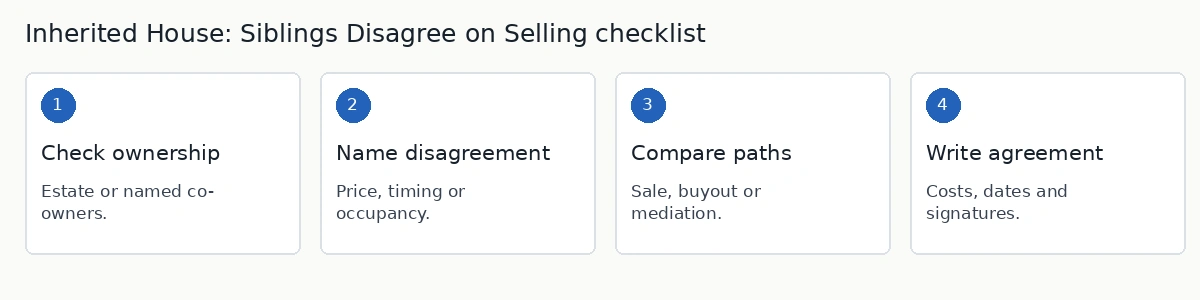
Confirm the records before making a sale decision.
Include the valuation date, written offers, mortgage payoff, taxes, insurance, utility expenses, necessary upkeep and moving arrangements. Separate paid invoices from projected costs. Identify who paid an expense and whether anyone agreed to reimbursement at the time.
For each option, show what remains after the proposed costs and how long the arrangement can be sustained. Do not treat a cash offer as identical to a hypothetical renovated listing price. Our inherited-home selling guide explains preparation choices, and the inherited-property tax guide covers a separate question: taxable gain is not simply the cash split.
Suppose a property is valued at $300,000 and has a $120,000 mortgage.
Consider mediation before a court dispute
Mediation can help the family define terms, but it does not itself replace the deed, required consent or legal documents. Establish which agreement would need to be signed afterward.
Bring the same valuation and expense packet to the discussion. Set a specific agenda: sale or buyout, occupancy deadline, expense treatment, belongings, communication and signing. Keep unrelated family disputes out of the sale worksheet as far as possible.
If agreement is reached, obtain the appropriate written documents before treating it as complete. If no agreement is possible, ask about the available state-law process rather than promising that any sibling can force a particular sale method or date.
Washington example: heirs-property rules are specific
Washington’s Uniform Partition of Heirs Property Act covers a defined category of property, not every home inherited by a family. Check applicability before borrowing its timelines.
RCW Chapter 7.54 includes tenancy-in-common and other requirements in its definition. In qualifying proceedings, RCW 7.54.050 provides a 45-day period after the statutory notice for certain cotenants to elect a buyout. That is not a universal deadline running from a relative’s death.
Under RCW 7.54.080, a court-ordered sale ordinarily uses the open market unless the court finds another permitted method more advantageous to the cotenants as a group. A private cash offer is not automatically a substitute for the court’s process. Other states have their own requirements; use this as a Washington example only.
Keep occupancy and carrying costs explicit
A sibling staying in the home and a sibling paying its bills can have different expectations. Resolve those expectations in writing instead of subtracting money unilaterally at closing.
List taxes, insurance, mortgage payments, repairs and utilities separately. Ask which obligations belong to the estate, the owners or an occupant under the applicable arrangements. Do not label every expense a debt owed by the other siblings. Retain receipts and identify unresolved claims before distributing funds.
For Washington transactions, the Washington seller page provides the related local selling context. It does not replace the ownership documents or court requirements.
When a cash sale may not be your best option
If a sibling can fund a fair, documented buyout and the others prefer it, a third-party sale may be unnecessary. A ready-to-list house may also bring a better net result through marketing.
Compare cash offers with listing only after the family establishes a lawful path. A quick closing is not a solution to missing authority or required consent.
Key takeaways
- Establish ownership before looking for buyers.
- Name the specific disagreement and use shared figures.
- A buyout requires funding and proper transfer documents.
- Expense reimbursement is not automatically settled by who paid.
- State partition procedures cannot be replaced by an informal offer.
Related seller guide
In Texas, families often document heirs with a recorded affidavit first. Read the Texas affidavit of heirship guide.
The bottom line
Start with one document packet and one written decision worksheet. Explore the inherited and probate hub or request a cash offer as a comparison figure when the sale authority is established. SilverCrest Estates can close in as little as 21 days when requirements allow, but family or court approvals may take longer.
Frequently asked questions
Can one sibling sell the entire inherited house alone?
Not merely because they inherited a share. Establish whether the estate still owns the property, who has sale authority and which signatures are required. Selling an individual interest and selling the entire house are different transactions.
What if one sibling wants to keep the house?
A documented buyout may work when the parties agree on value, costs, financing and timing. Verify title and the existing loan before assuming that paying siblings automatically transfers ownership or releases anyone’s loan obligation.
Does every inherited home qualify as heirs property under Washington law?
No. RCW Chapter 7.54 defines a specific category of tenancy-in-common property with additional requirements. A court determines whether the Act applies; ordinary inheritance alone does not establish that status.
Sources & further reading
Primary sources we consulted for this article. Rules vary by state and change over time — always confirm against the original source.
- 1RCW Chapter 7.54: Uniform Partition of Heirs Property Act
Washington State Legislature
Washington statutory heirs-property definition and partition protections.
- 2RCW 7.54.050: Cotenant buyout
Washington State Legislature
Specific 45-day election period after notice in qualifying proceedings.
- 3RCW 7.54.080: Open market sale
Washington State Legislature
Court-directed sale methods and the ordinary open-market process.

About the author
Jennifer Martinez
Real Estate Consultant
Jennifer Martinez works with the SilverCrest Estates acquisitions team, helping homeowners across 50+ US markets understand their options and close on their own timeline.
Disclaimer: This article is for general information only and is not legal, tax, or financial advice. Real estate rules vary by state and change over time. Consult a licensed attorney, tax professional, or financial advisor about your specific situation before acting.