Start here: this article is part of our inherited property collection. For the full picture, read our complete guide, How to Sell a House in Probate: Step-by-Step Guide for Executors and Heirs.
Quick answer: A Texas affidavit of heirship is a sworn, recorded statement of a deceased owner's family history that identifies the heirs when there is no will. It is not a court order, but title companies often accept it to sell inherited property. SilverCrest Estates sees it work best when the family is simple, every heir agrees, and no probate is needed for debts.
| Question | Short answer |
|---|---|
| When is it used? | Owner died without a will and no estate was opened |
| Who signs? | A person who knew the family, often with witnesses |
| Where is it filed? | County clerk's deed records where the land sits |
| Is it enough to sell? | Often yes, if the title company accepts it |
General education, not legal advice.
What is an affidavit of heirship in Texas?
It is a sworn statement of facts about the person who died: marriages, children, and other family members who inherit under Texas law. Once recorded in the county deed records, it becomes part of the property's title history.
The Texas Estates Code, chapter 203, sets out how these statements are treated. Under section 203.001, a court must receive a recorded statement of family history as prima facie evidence of the facts in it once the affidavit has been of record for five years or more in the county where the property is located. Section 203.002 provides a form. Before five years pass, the affidavit is still useful because title insurers can rely on it under their own underwriting rules.
Does an affidavit of heirship transfer title in Texas?
Not by itself. Heirs receive title by law when the owner dies without a will; the affidavit documents who those heirs are. That is why a sale still needs every heir, or their legal representative, to sign the deed to the buyer.
When an affidavit of heirship works
It works when the owner died without a will, no probate is needed, the family tree is clear, and all heirs agree to sell. It is common for a parent's house where the surviving family is a spouse and adult children.
It is weaker when there is a will, when heirs are missing or disagree, when there are significant debts, or when a court needs to appoint someone to act. In those cases a title company may ask for a court proceeding instead. A will must generally be offered for probate within four years of death under Estates Code section 256.003, after which the options narrow.
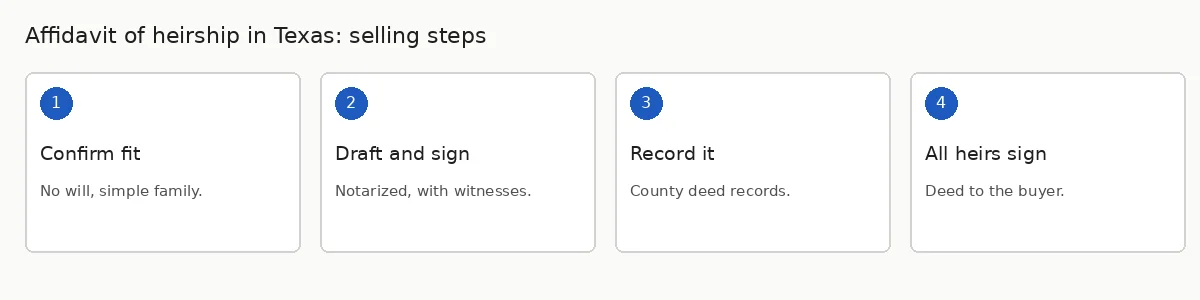
Affidavit of heirship in Texas: selling steps
- 1
Confirm fit
No will, simple family.
- 2
Draft and sign
Notarized, with witnesses.
- 3
Record it
County deed records.
- 4
All heirs sign
Deed to the buyer.
Confirm the title company will accept it before you record.
Who can sign an affidavit of heirship?
The person signing should know the family history personally, such as a longtime friend, neighbor or relative. Many title companies prefer one or two disinterested witnesses, meaning people who do not inherit, so the facts are independently confirmed.
The signer swears to facts before a notary: dates of death and marriage, each child, any divorces, and whether the deceased left a will. Bring death certificates and marriage or divorce records. Errors cause problems later, so take the time to get every family member right.
Can I do my own affidavit of heirship in Texas?
You can prepare one using the section 203.002 form, but the more useful question is whether your title company will accept it. Ask the title company first; many have their own form and witness requirements.
You can prepare one using the section 203.002 form, but the more useful question is whether your title company will accept it.
Recording the affidavit with the county clerk
Record the signed affidavit in the deed records of each county where the deceased owned real property. Recording puts the family history into the chain of title.
- Harris County: the Harris County Clerk records real property documents, including affidavits of heirship.
- Dallas County: the Dallas County Clerk handles real property recordings for the county.
- Bexar County: the Bexar County Clerk records deeds and related instruments.
Check each office's current recording fees and formatting rules before you file.
Other Texas options when an affidavit is not enough
Texas offers court and non-court alternatives. The right one depends on whether there is a will and what the estate owes.
| Option | Use when |
|---|---|
| Determination of heirship | A court should declare the heirs, under Estates Code chapter 202 |
| Small estate affidavit | No will, limited estate; real property only if it is the homestead |
| Muniment of title | A will exists and the estate has no unpaid debts other than those secured by real estate |
| Full administration | Debts, disputes or a sale needing court authority |
Under Estates Code section 205.006, a small estate affidavit can transfer title to a homestead when it is the only real property in the estate. A determination of heirship under chapter 202 is a court proceeding that results in a judgment declaring the heirs. Our probate house sale guide explains the court path, and selling a house after death without probate compares the non-court options.
Worked example: selling a parent's Houston house
Illustrative numbers only. A father dies without a will, owning a house in Houston worth about $230,000 as-is, with a $41,000 mortgage. He was divorced and has three adult children, so they inherit equally.
A family friend of 30 years signs the affidavit with a neighbor as a second witness, and it is recorded in Harris County. The title company accepts it. All three children sign the deed at a $221,000 sale. After paying the $41,000 loan and $7,500 in costs, each child receives about $57,500. The mortgage servicer's payoff is handled at closing; see what happens to a mortgage when the owner dies.
When heirs disagree
An affidavit only documents who inherits. It cannot make an heir sign. If one sibling refuses, the sale stalls until the family agrees, buys that heir out, or goes to court.
Our guide to inherited houses when siblings disagree covers buyouts and partition. If you suspect an unknown heir, such as a child from an earlier relationship, tell the title company before recording; Texas protects bona fide buyers who rely on recorded affidavits only in limited ways, and missing heirs are the most common reason a deal fails.
When a cash sale may not be your best option
A cash sale is not the obvious pick if the house is in good condition, the heirs have time, and nobody needs money quickly. Listing with an agent may bring a higher price once title is cleared.
Compare written numbers in the cash offer vs listing guide. A direct sale fits better when the house needs repairs, the heirs live out of state, or the family wants one closing date. The probate and inherited property hub and the Texas sell page have more.
Key takeaways
- A Texas affidavit of heirship documents heirs when there is no will.
- It is recorded with the county clerk and becomes prima facie evidence after five years.
- It does not transfer title on its own; every heir still signs the deed.
- Title companies set their own acceptance and witness rules, so ask first.
- Court options or a small estate affidavit fit when the facts are not simple.
The bottom line
Confirm the title company will accept an affidavit of heirship, get it signed and recorded, and line up every heir's signature. When the family is ready, request a no-obligation cash offer; SilverCrest Estates can close in as little as 21 days once title is insurable.
Frequently asked questions
Does an affidavit of heirship transfer title in Texas?
Not by itself. Heirs receive title by law when the owner dies without a will; the affidavit documents who they are. Every heir, or a legal representative, still signs the deed to a buyer.
Can I do my own affidavit of heirship in Texas?
You can prepare one using the form in Estates Code section 203.002, but ask the title company first. Many have their own form and want one or two disinterested witnesses who know the family.
When does an affidavit of heirship become evidence in Texas?
Under Estates Code section 203.001, a court receives a recorded statement of family history as prima facie evidence once it has been in the county deed records for five years or more.
Sources & further reading
Primary sources we consulted for this article. Rules vary by state and change over time — always confirm against the original source.
- 1Texas Estates Code chapter 203
Texas Constitution and Statutes
Recorded statements of family history and the five-year rule.
- 2Texas Estates Code chapter 205
Texas Constitution and Statutes
Small estate affidavit and homestead transfer.
- 3Texas Estates Code chapter 256
Texas Constitution and Statutes
Four-year period to admit a will to probate.
- 4

About the author
David Park
Senior Advisor
David Park works with the SilverCrest Estates acquisitions team, helping homeowners across 50+ US markets understand their options and close on their own timeline.
Disclaimer: This article is for general information only and is not legal, tax, or financial advice. Real estate rules vary by state and change over time. Consult a licensed attorney, tax professional, or financial advisor about your specific situation before acting.