
Start here: this article is part of our seller questions collection. For the full picture, read our complete guide, Can You Sell a House With a Mortgage? Everything You Need to Know.
Quick answer: Home-sale proceeds wire fraud can target the seller’s payment details or a mortgage payoff. Establish trusted contacts before closing, independently verify unexpected changes, and contact the bank immediately if funds may be diverted. SilverCrest Estates recommends four checkpoints: agreed contacts, verified instructions, confirmed disbursement and preserved records. A cash sale does not eliminate fraud risk.
| Checkpoint | Seller action |
|---|---|
| Before closing | Save independently verified contact numbers |
| Changed instructions | Pause and confirm through those contacts |
| Disbursement | Confirm the agreed payment procedure |
| Suspected diversion | Contact bank and closing professional immediately |
Why sellers need their own wire-fraud checklist
Sellers can be targets even when they are receiving rather than sending money. Payment instructions and mortgage payoff details are valuable targets for impersonation.
The California Department of Real Estate alert explicitly warns sellers, buyers and transaction participants about fraudulent electronic-transfer instructions. A criminal may appear to be a trusted participant and insert different account information into an otherwise ordinary exchange.
A genuine buyer, signed contract and familiar email thread do not establish that every later message is genuine. Keep verification focused on the payment procedure and recipient details. Our cash-buyer legitimacy guide covers business verification; this guide addresses a different risk near disbursement.
Establish trusted contacts before money moves
Verification works best when contact details are established before a suspicious message arrives. Do not build the verification process from information in that message.
At the beginning of closing, confirm the settlement professional’s name and trusted phone number using an independent source you already know. Ask how seller account information will be collected, how changes are verified and which person confirms disbursement. Save that procedure with your contract.
The CFPB closing-scam guidance is written principally for buyers, but its independent-contact safeguards are relevant to seller communication too. Do not misread it as a guarantee about seller funds or a specific closing company’s controls.
If multiple relatives or agents are involved, identify who is authorized to communicate payment details. An unplanned new participant can complicate verification even without fraud. Keep the closing professional informed rather than forwarding sensitive account details through a long family email chain.
Treat changed instructions as a reason to pause
An unexpected account change, urgent payment demand or new contact number needs independent verification. Familiar branding is not enough.
Criminals can use convincing signatures, copied documents and a message that fits an ongoing conversation. Do not decide authenticity solely from spelling, logos or the sender’s displayed name. A polished message may still be fraudulent.
Call the established trusted contact, not a number supplied with the new instructions. Ask them to verify the change through their approved process. Do not click an unfamiliar link to confirm your bank details or download a document merely because it says final closing update. Keep account information out of ordinary reply chains when the settlement professional provides a safer procedure.
What if the email looks exactly like the earlier messages?
Appearance does not establish control of the sending account. Pause the requested change and independently confirm it anyway.
Explain precisely what changed and when you received it. Preserve the message while verification takes place. Do not assume that replying to the same thread reaches the real person. Likewise, forwarding the message to another unverified address does not resolve the underlying identity question.
Distinguish seller proceeds from a mortgage payoff
The seller’s remaining proceeds and the lender’s payoff are different destinations. Both need the correct process, and one confirmation does not verify the other.
Use the signed settlement statement to understand which funds go where. Ask the closing professional how the mortgage payoff statement was obtained and how any updated payoff will be verified. The mortgage sale guide explains why payoff figures can differ from an ordinary monthly statement.
You do not need to become a banking investigator. You do need to avoid supplying or approving different instructions outside the established procedure. If a supposed lender asks you to transfer money personally at the last minute, stop and consult the real closing professional using the contact already saved.
A seller expects $145,000 after mortgage payoff and closing adjustments.
Use a four-step closing-week check
A repeatable check reduces improvisation when everyone is rushing. Record confirmation without spreading sensitive account information unnecessarily.
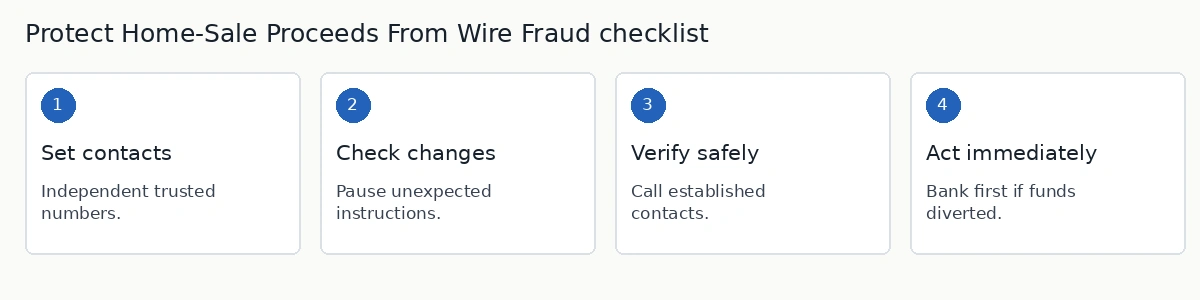
Protect Home-Sale Proceeds From Wire Fraud checklist
- 1
Set contacts
Independent trusted numbers.
- 2
Check changes
Pause unexpected instructions.
- 3
Verify safely
Call established contacts.
- 4
Act immediately
Bank first if funds diverted.
Confirm the records before making a sale decision.
First, verify the closing date and the disbursement process through trusted contacts. Second, confirm how the settlement professional obtained the payment information. Third, question any late change instead of treating urgency as evidence. Fourth, confirm the payment outcome through your bank and the closing professional.
The closing-day guide covers the broader documents and signing process. Keep this payment check alongside those records, not in place of them. Possession dates, recorded documents and receipt of money are distinct milestones.
Worked example: the urgent account-change message
This scenario is an example, not a reported SilverCrest case. A seller expects $145,000 after mortgage payoff and closing adjustments. On the morning of closing, an email appears to request a substitute receiving account and says the transfer must happen immediately.
The seller does not respond with account credentials. They call the previously confirmed settlement number, describe the message and ask for the approved verification process. If the real professional says no change was requested, the seller preserves the email and follows their security instructions. The dollar amount is not what determines suspicion; the unverified change is.
No checklist guarantees that fraud will be detected. The value of the example is the pause and independent verification, not a promise of perfect prevention.
Act immediately if money may have been diverted
Contact the bank and real closing professional as soon as you suspect diversion. Do not wait for the sender of a suspicious message to explain it.
The CFPB checklist advises immediate contact with the bank or transfer company after suspected fraud. Ask about stopping or recalling the transfer and follow the institution’s fraud procedure. Recovery is not guaranteed, even when you act quickly.
Preserve emails, attachments, phone numbers, timestamps and transaction records. Ask the bank and closing professional what reports and documentation are needed, and report the incident through appropriate law-enforcement channels. Do not delete the message out of embarrassment or forward credentials to someone promising a recovery service.
Confirm outcomes without assuming a usual wait
An expected deposit that has not appeared should be investigated through established contacts. Do not treat a criminal’s explanation of a delay as verification.
Ask the closing professional to confirm the transfer status and your bank to confirm what it can see. Use their secure process for transaction details. Do not publish bank numbers or screenshots in a public complaint, and redact sensitive information before seeking unrelated advice.
Keep the final settlement statement, confirmed receipt and any corrected instructions in the closing file. If you later receive another message about a refund, fee or account update, use the same independent-contact discipline.
When a cash sale may not be your best option
A cash sale does not make electronic payments immune to impersonation. Do not choose a lower offer because someone says cash eliminates closing fraud.
Compare cash offers with listing on price, terms, timing and net proceeds. A ready-to-list home may produce a better result through marketing. Whichever method you choose, use verified payment procedures and qualified settlement professionals.
Key takeaways
- Seller proceeds and mortgage payoffs can both be targeted.
- Save trusted contact details before closing.
- Independently verify unexpected changes.
- Contact the bank immediately after suspected diversion.
- Preserve records; never assume recovery is guaranteed.
The bottom line
Protect the disbursement with the same care you give the contract. Review the relocation hub for move planning or request a written cash offer to compare sale options. SilverCrest Estates can close in as little as 21 days when requirements allow, but faster timing should never replace payment verification.
Frequently asked questions
Can sellers lose sale proceeds to wire fraud?
Yes. A criminal may impersonate a seller or closing participant and substitute payment details. The California real estate regulator expressly warns sellers about electronic-transfer fraud; cash transactions are not automatically immune.
Should I trust new instructions from a familiar email address?
No. Familiar names and email threads can be impersonated or compromised. Pause and verify unexpected changes through an independently established contact, not a phone number or link supplied in the suspicious message.
What should I do if my proceeds may have been diverted?
Contact the sending bank and closing professional immediately through trusted numbers and ask about stopping or recalling the transfer. Preserve messages and report suspected fraud. Prompt action matters, but recovery is not guaranteed.
Sources & further reading
Primary sources we consulted for this article. Rules vary by state and change over time — always confirm against the original source.
- 1Consumer alert: Wire fraud
California Department of Real Estate
Warns sellers and buyers about impersonated electronic-transfer instructions.
- 2Beware mortgage closing scams
Consumer Financial Protection Bureau
Trusted contacts and verification; the original guidance addresses buyers.
- 3Mortgage closing scams checklist
Consumer Financial Protection Bureau
Independent verification and immediate contact with the bank after suspected fraud.

About the author
David Park
Senior Advisor
David Park works with the SilverCrest Estates acquisitions team, helping homeowners across 50+ US markets understand their options and close on their own timeline.
Disclaimer: This article is for general information only and is not legal, tax, or financial advice. Real estate rules vary by state and change over time. Consult a licensed attorney, tax professional, or financial advisor about your specific situation before acting.