Start here: this article is part of our seller questions collection. For the full picture, read our complete guide, Can You Sell a House With a Mortgage? Everything You Need to Know.
Quick answer: Selling a house after a spouse dies usually starts with the deed. SilverCrest Estates suggests checking whether you owned the home as joint tenants or tenants by the entirety, recording the death certificate to show sole ownership, confirming mortgage successor rights, and timing the sale around the two-year surviving spouse exclusion if the gain is large.
| How the deed reads | What usually happens |
|---|---|
| Joint tenants with survivorship | Survivor owns it; record death |
| Tenants by the entirety | Survivor owns it; record death |
| Tenants in common | Spouse's share passes by will or law |
| Only the spouse on title | Estate or transfer process needed |
Start with how the deed was titled
Ownership form decides whether you can sell on your own. Find the recorded deed before anything else.
Request a copy from the county recorder or check the title policy from your purchase. Look for the words that follow your names:
- Joint tenants with right of survivorship. The Cornell joint tenancy overview explains that the survivor takes the whole property automatically.
- Tenants by the entirety. Available to married couples in many states; the Cornell entry describes the same survivorship result.
- Tenants in common. Each spouse owns a share that passes under a will or state law, as the Cornell tenancy in common entry notes.
- Community property with right of survivorship. Used in some community property states and generally also passes to the survivor.
Our glossary pages on joint tenancy and the right of survivorship give short definitions.
Record the death to clear title
Survivorship works automatically in law, but the public record still shows two owners. The title company needs paperwork.
Most counties accept a certified death certificate with an affidavit of survivorship or death of joint tenant. Some states use a specific form; the recorder's office or title company can tell you which. Once it is recorded, you can sign the deed alone.
If the deed was tenants in common or only your spouse was on title, the share usually passes through probate, a small-estate procedure or a trust. Our guides to selling without probate and selling a house in probate explain those paths. If the home was held in a trust, see selling a house in a trust.
Check the mortgage and the payments
The mortgage does not disappear when a borrower dies. Keep payments current while you plan.
Federal rules protect a surviving spouse who takes title. Our guide to what happens to a mortgage when the owner dies explains how successors in interest can get account information and why lenders generally cannot call the loan due solely because of the transfer to a spouse. Ask the servicer for a payoff statement before you price the sale.
Use the surviving spouse tax rules
Taxes can be the largest money decision in this situation. Two federal rules usually help.
The two-year $500,000 window
IRS Publication 523 lets a surviving spouse exclude up to $500,000 of gain, rather than $250,000, when the house is sold within two years of the death, the survivor has not remarried before the sale, and the couple met the ownership and use requirements right before the death. After that window, the single-filer $250,000 limit generally applies.
Basis adjustment on the spouse's share
The deceased spouse's portion of the house generally receives a basis adjusted to its value at death. In community property states, the whole property may qualify. Our guide to capital gains on inherited property explains how the step-up works.
Worked example: the two-year window
These numbers are an example only, not a SilverCrest Estates case. A couple bought a house for $180,000 as joint tenants. The husband dies when it is worth $520,000. The widow sells 14 months later for $540,000.
Selling a house after a spouse dies: sequence
- 1
Read the deed
Joint, entirety or common.
- 2
Record the death
Certificate and affidavit.
- 3
Check the mortgage
Successor rights.
- 4
Plan the tax
Two-year window.
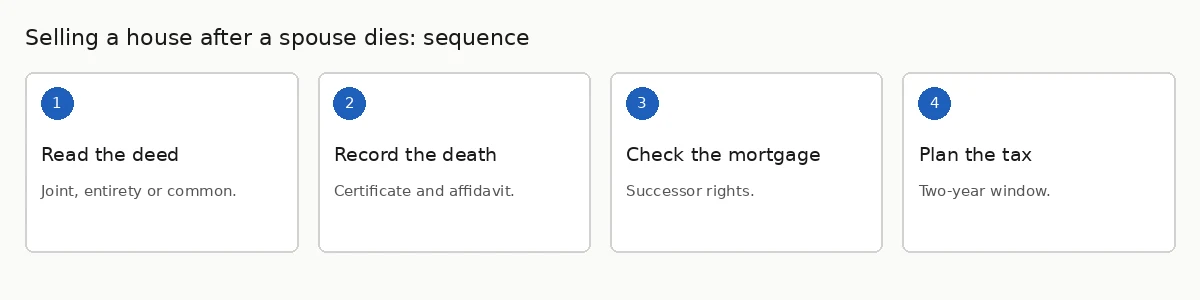
Title first, then taxes, then timing.
In a common law state, half the basis steps up: $90,000 for her original half plus $260,000 for his half, a basis of $350,000. The gain of about $190,000 before selling costs falls well inside the $500,000 limit because she sold within two years. Waiting past the window would cap the exclusion at $250,000, which would still cover this gain but not a larger one.
After that window, the single-filer $250,000 limit generally applies.
Practical steps in the first months
Grief makes paperwork harder. A short list keeps the sale on track.
- Order several certified death certificates.
- Notify the homeowners insurance carrier and keep the policy active.
- Keep utilities on and the house secured, especially if you move out.
- Collect the deed, mortgage statements and property tax bills.
- Decide whether to sell now or after you are settled, with the two-year date on your calendar.
If you plan to move to a smaller home or near family, our downsizing guide covers the move side.
Common questions from surviving spouses
A few questions come up in almost every conversation. The short answers below assume a simple joint deed.
Do I need my children's signatures?
Usually not. When the deed was joint with survivorship or tenancy by the entirety, the surviving spouse owns the whole house and signs alone. Children may need to sign only when they inherited a share, such as under a tenancy in common.
What if there is a reverse mortgage?
A reverse mortgage has its own rules for surviving spouses, including whether a non-borrowing spouse may stay. Our reverse mortgage sale guide explains the payoff and timing.
Should I wait a year before deciding?
Many advisers suggest avoiding big decisions in the first months, if money allows. Keep the two-year tax date in mind so a pause does not cost you the larger exclusion.
What about property tax exemptions?
Some exemptions, such as a senior or veteran exemption, may change after a death. Call the county assessor so the next bill is accurate.
When a cash sale may not be your best option
You are not required to sell quickly. If the house is in good shape and you can stay, listing later may net more.
A cash sale helps most when the house needs repairs you cannot manage, you live far away, or you want one fixed moving date. Compare a cash offer with listing before deciding.
Key takeaways
- The deed's wording decides whether you can sell alone.
- Record a death certificate and affidavit to show sole ownership.
- Keep the mortgage current and request a payoff.
- Sell within two years to keep the $500,000 exclusion if you qualify.
- Your spouse's share usually gets a basis adjustment.
The bottom line
Confirm title, record the death, and pick a sale date that fits both your life and the tax window. Visit the probate and inherited homes hub for related guides, or request a written cash offer when you are ready; SilverCrest Estates can close in as little as 21 days once title is clear.
Frequently asked questions
Do I need probate to sell my house after my spouse dies?
Often not, if the deed held the house as joint tenants with right of survivorship or as tenants by the entirety. The surviving spouse usually records a death certificate and an affidavit, then sells as sole owner.
Can a surviving spouse still use the $500,000 home sale exclusion?
IRS Publication 523 allows a surviving spouse to claim up to $500,000 if the sale happens within two years of the death, the survivor has not remarried, and the couple met the requirements just before the death.
What if my spouse's name is on the deed as tenants in common?
Then your spouse's share usually passes under the will or state law, which may require probate or another transfer process before you can sell the whole house.
Sources & further reading
Primary sources we consulted for this article. Rules vary by state and change over time — always confirm against the original source.
- 1
- 2
- 3
- 4

About the author
Lisa Anderson
Homeowner Advocate
Lisa Anderson works with the SilverCrest Estates acquisitions team, helping homeowners across 50+ US markets understand their options and close on their own timeline.
Disclaimer: This article is for general information only and is not legal, tax, or financial advice. Real estate rules vary by state and change over time. Consult a licensed attorney, tax professional, or financial advisor about your specific situation before acting.