
Start here: this article is part of our inherited property collection. For the full picture, read our complete guide, How to Sell a House in Probate: Step-by-Step Guide for Executors and Heirs.
Quick answer: Selling a house with a life estate usually requires both the life tenant and every remainderman to sign the deed, because each owns part of the property. Proceeds are then split by the value of each interest, often using IRS actuarial factors. SilverCrest Estates recommends confirming the deed wording, every owner's signature authority and any Medicaid estate-recovery exposure before accepting an offer.
| Who holds what | Can they sell alone? |
|---|---|
| Life tenant | Only their lifetime right to use the home |
| Remainderman | Only their future interest |
| Both together | Yes, they can convey full ownership |
| Enhanced life estate deed | Depends on state law and deed wording |
How a life estate splits ownership
A life estate divides ownership over time. The life tenant has the right to live in or use the home for life, and the remaindermen receive full ownership when the life tenant dies.
The Cornell Legal Information Institute describes a life estate as an interest that lasts for the life of a person, followed by a future interest held by others. Parents often create one by deeding the house to their children while keeping a life estate, which can keep the home out of probate. Our glossary entry for life estate gives the short definition.
The arrangement works well until someone needs to sell. At that point, the interests that were separated have to be brought back together.
Who must sign the deed
In a standard life estate, every owner of an interest must join the sale to give a buyer full title. Missing one signature leaves a gap the title company will not insure.
A life tenant acting alone can only sell their lifetime interest, which few buyers want. A remainderman acting alone can only sell a future interest. Together, the life tenant and all remaindermen can sign one deed and convey the whole property.
Check for these complications early:
- A remainderman has died. Their interest may pass through their estate, which can require probate. See our guide to selling a house in probate.
- A remainderman is a minor or lacks capacity. A guardian or court approval may be required.
- The life tenant lacks capacity. An agent under a valid power of attorney may be able to sign if the document grants real estate authority; our power of attorney guide explains what to check.
- A remainderman is married. Some states require a spouse to sign or release marital rights.
What about an enhanced life estate deed?
An enhanced life estate deed, sometimes called a Lady Bird deed, is recognized in only a few states. It generally lets the life tenant sell without the remaindermen.
Because availability and effect depend on state law and the exact deed language, ask the title company to review the recorded deed before you assume one person can sign. Do not rely on a family memory of what the deed was meant to do.
How sale proceeds are divided
When a life estate property sells, the proceeds are usually divided by the value of each interest. The older the life tenant, the smaller the life estate's share.
The IRS actuarial tables supply the factors used to value life and remainder interests for tax purposes, and families or courts often use them as a starting point. The parties can also agree to a different split, for example if the life tenant needs the full amount to pay for care.
Worked example: splitting a $300,000 sale
The figures are an example only, and the factor is illustrative, not taken from a current table. A life tenant and two remaindermen sell for $300,000 and net $282,000 after closing costs.
Selling a house with a life estate: closing path
- 1
Read the deed
Standard or enhanced.
- 2
List every owner
Life tenant and remaindermen.
- 3
Agree the split
Factor or written deal.
- 4
Sign one deed
All interests convey together.
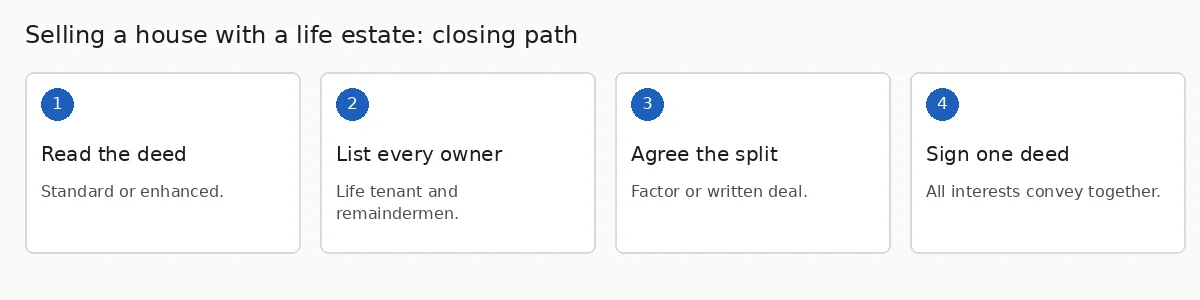
Confirm every interest before choosing a buyer.
If the illustrative life estate factor is 0.40, the life tenant would receive about $112,800 and the remaindermen would share about $169,200, or $84,600 each. A written agreement signed before closing tells the settlement agent exactly how to disburse funds. Without one, closing can stall on the day money is due.
A life tenant and two remaindermen sell for $300,000 and net $282,000 after closing costs.
Tax effects to check before you sign
Selling during the life tenant's lifetime can change the tax result compared with inheriting the house later. Run the numbers first.
The IRS guidance on basis, Publication 551, explains how basis is determined for property acquired by gift and from a decedent. When parents keep a life estate, the home is often included in their estate at death, which can give the remaindermen a basis based on value at that time. Selling earlier may mean the remaindermen's share is measured against the parents' older basis instead. The life tenant may also qualify for the home-sale gain exclusion on their portion if they meet the ownership and use rules. A tax preparer can apply these rules to your family's figures.
Our article on capital gains on inherited property explains stepped-up basis in more detail.
Medicaid and estate recovery
If the life tenant receives Medicaid long-term care benefits, the sale and the proceeds can affect eligibility and recovery. This is a state-by-state question.
Federal rules require states to seek recovery of certain Medicaid costs from a beneficiary's estate, and states may define the estate broadly enough to include interests such as life estates, as explained on Medicaid.gov's estate recovery page. The life tenant's share of sale proceeds may also count as a resource. Contact the state Medicaid agency before closing so the proceeds do not unexpectedly end benefits. Our guide to selling a parent's house for assisted living covers the care-funding side.
Steps to sell without surprises
A short sequence prevents most problems. Do it before signing a purchase contract.
- Order the recorded deed and a preliminary title report.
- Confirm every owner's legal name, address and capacity to sign.
- Agree in writing how proceeds will be divided.
- Check tax and Medicaid effects with the right professionals.
- Choose a buyer and closing date that allow everyone to sign, including remotely.
Remote signing and mail-away packages are common when remaindermen live in different states. Ask the title company early which notarization methods it accepts.
When a cash sale may not be your best option
A life estate does not by itself require a cash sale. If the home is in good shape and all owners agree, listing can produce a higher price.
A cash buyer helps most when the house needs work, the life tenant has moved to care on a deadline, or owners are spread across states and want one fixed closing date. Compare cash offers with listing on net proceeds after any repair costs.
Key takeaways
- A standard life estate splits ownership between the life tenant and remaindermen.
- Usually everyone must sign to sell the whole property.
- Proceeds are typically divided by the value of each interest.
- Selling early can change capital-gains results for remaindermen.
- Check Medicaid effects before the life tenant receives proceeds.
The bottom line
Gather every signature and a written split before you sell. Visit the probate and inherited property hub for related guides, or request a written cash offer once the owners agree; SilverCrest Estates can close in as little as 21 days when title is ready.
Frequently asked questions
Can a life tenant sell the house alone?
In a standard life estate, no. The life tenant can only sell their lifetime interest. To convey full ownership, the life tenant and every remainderman usually must sign the same deed, unless an enhanced life estate deed recognized in that state allows otherwise.
How are proceeds split when a life estate house is sold?
Proceeds are usually divided by the value of each interest. IRS actuarial factors are a common starting point, but the owners can agree in writing to a different split before closing.
Does selling a life estate affect Medicaid?
It can. The life tenant's share of proceeds may count as a resource, and some states include life estates in estate recovery. Contact the state Medicaid agency before closing.
Sources & further reading
Primary sources we consulted for this article. Rules vary by state and change over time — always confirm against the original source.
- 1
- 2
- 3Publication 551, Basis of Assets
Internal Revenue Service
Basis of property received by gift or from a decedent.
- 4

About the author
Sarah Williams
Senior Real Estate Analyst
Sarah Williams works with the SilverCrest Estates acquisitions team, helping homeowners across 50+ US markets understand their options and close on their own timeline.
Disclaimer: This article is for general information only and is not legal, tax, or financial advice. Real estate rules vary by state and change over time. Consult a licensed attorney, tax professional, or financial advisor about your specific situation before acting.