
Start here: this article is part of our inherited property collection. For the full picture, read our complete guide, How to Sell a House in Probate: Step-by-Step Guide for Executors and Heirs.
Quick answer: Selling parents’ house with power of attorney depends on the document’s real estate powers, its effective status and state requirements. Being an adult child is not authority. SilverCrest Estates recommends four checks before a contract: identify the owner, verify your signing power, document the parent’s interests, and arrange separate records and sale proceeds.
| Check | Bring to the closing professional |
|---|---|
| Ownership | Current deed and names of owners |
| Authority | Complete power-of-attorney document |
| Decision | Offers, valuation and reasons for the sale |
| Funds | Owner account and disbursement plan |
Identify who owns the house and who can act
The deed and the authority document answer different questions. A power of attorney can authorize action without making the agent an owner.
Start by checking the current owner names. Then establish your role: owner, agent under power of attorney, trustee, guardian or estate representative. Those roles are not interchangeable. The CFPB publishes separate guides because each relationship carries its own authority and responsibilities.
This article concerns a living parent and an agent acting under a financial power of attorney. A parent’s death changes the authority question; do not keep signing under the same document without establishing the proper estate or trust authority. Our trust-sale guide covers a different ownership arrangement.
Read the power of attorney before accepting an offer
The complete document must support the transaction you intend to make. A document’s title is not enough to establish its powers or conditions.
The CFPB’s explanation distinguishes durable planning authority from short-term arrangements. Durable generally means the document continues to be effective after incapacity. It does not mean every real estate action, gift or transfer is permitted.
Give the complete document, including attachments and amendments, to the closing professional early. Ask which state requirements apply, whether the authority is currently effective, whether other signatures are needed and how the document must be presented at closing. Do this before promising a date or signing a purchase agreement. A cash sale does not remove these requirements.
Can I sell my parents house with power of attorney?
Possibly, but the answer depends on the effective powers and the transaction. Ask the closing professional to identify what supports your authority in this particular sale.
Do not assume a financial POA automatically covers a gift, a below-market family transfer, borrowing or a sale to yourself. If the plan involves one of those actions, explain it explicitly instead of describing it as an ordinary sale. Reader-specific legal advice may be appropriate when your document or state requirements are unclear.
Put the parent’s interests ahead of your convenience
An agent acts for the parent, not for the agent’s preferred outcome. The reason for selling and the offer comparison should reflect the parent’s needs.
The CFPB identifies four fiduciary duties: act only in the person’s best interest, manage carefully, keep money and property separate, and keep good records. Use those duties as a practical checklist for the sale.
Record why the sale is being considered, what housing arrangements will follow, and what costs the parent would carry while waiting. If the parent can participate, preserve their preferences rather than treating incapacity planning as permission to exclude them. Family agreement may reduce conflict, but it is not a substitute for the owner’s rights or the agent’s actual authority.
Suppose a listing sale could produce $320,000, with $22,000 of selling costs, $15,000 of necessary preparation and $6,000 of carrying costs.
Compare offers using a decision record
A written comparison explains why an offer was accepted. The highest headline price and the best overall outcome are not always identical.
Selling Parents’ House With Power of Attorney checklist
- 1
Identify role
POA, owner, trustee or guardian.
- 2
Verify power
Document and state rules.
- 3
Compare offers
Record the parent’s interest.
- 4
Protect funds
Separate money and receipts.
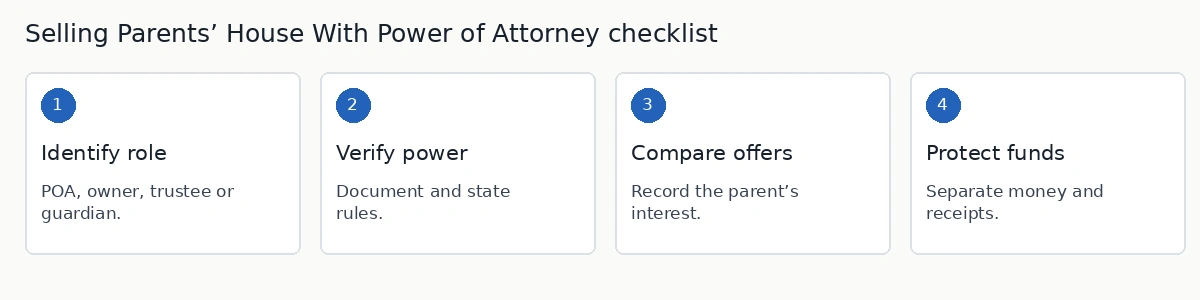
Confirm the records before making a sale decision.
Keep valuation information, written offers, proposed dates, inspection terms, expenses and any repair quotes. Explain the trade-offs in plain language. If avoiding cleanout or coordinating a move matters, identify the actual cost and burden rather than merely saying the sale was easier for you.
Worked example: choosing an offer for the parent
These figures are examples, not typical pricing, tax guidance or SilverCrest results. Suppose a listing sale could produce $320,000, with $22,000 of selling costs, $15,000 of necessary preparation and $6,000 of carrying costs. The example net before mortgage payoff is $277,000.
A $286,000 as-is offer with $3,000 of other seller costs and $1,500 of carrying costs produces $281,500 before the same payoff. That is $4,500 more in this illustration. If the listing price or preparation estimate changes, the result may reverse. Preserve the source of each figure and the written offer terms instead of saving only the final total.
Keep sale proceeds separate and traceable
The parent’s property should not become mixed with the agent’s personal money. Plan the disbursement before closing day.
Ask the closing professional which account must receive funds and what evidence of ownership or authority is required. Do not supply your own personal account simply because you handle the paperwork. Keep the settlement statement, payoff confirmations, bank receipt and every sale-related invoice together.
A simple ledger should show each expense, who paid it, the reason and the receipt. If you advanced money, document it; do not reimburse yourself from proceeds without establishing that reimbursement is authorized. Separate financial records also make later questions from family members easier to answer.
Coordinate the move without expanding your authority
Care placement and signing power are separate problems. A facility deadline does not automatically authorize a sale or shorten the title review.
Use the assisted-living sale guide for moving logistics. Confirm what remains in the home, how belongings will be handled, and whether the parent needs a later possession date. Tell buyers about the actual schedule without promising a closing you cannot yet support.
If you are arranging the sale from another state, the out-of-state guide explains practical coordination. Do not assume remote signing is accepted just because another relative used it in a different transaction.
Pause when the facts or powers are uncertain
Unclear authority should be resolved before a binding commitment, not at the signing table. Good recordkeeping cannot cure a missing legal power.
Pause if documents conflict, the ownership record differs from your understanding, a revocation is alleged, your parent’s preferences are disputed, or the transaction benefits you personally. Ask the closing professional exactly what additional documents or legal clarification are needed. Never present a copy as complete if pages are missing.
When a cash sale may not be your best option
A well-maintained home with time for marketing may net more through a listing. The parent’s needs, not the agent’s preferred convenience, should decide.
Compare cash offers with listing. If authority is unresolved, neither sale method is ready. SilverCrest Estates can provide a written number for comparison, but it cannot turn a family relationship into legal permission to sign.
Key takeaways
- Identify the owner and your exact role.
- Durable does not mean unrestricted.
- Verify powers before signing a contract.
- Keep the offer decision and the parent’s funds documented.
- Resolve conflicting authority before committing to a date.
The bottom line
Begin with the documents, then compare the sale choices for the parent’s benefit. Browse the senior-transition hub or request a cash offer once the ownership and signing questions are clear. SilverCrest Estates can close in as little as 21 days when title and other requirements allow; unresolved authority can take longer.
Frequently asked questions
Can I sell my parents house with power of attorney?
Possibly, if the effective document grants the necessary real estate authority and applicable state requirements are met. Being their child does not give you that power. Have the closing professional confirm the document before signing a contract.
Does durable power of attorney mean unlimited power?
No. Durable generally means the authority continues after incapacity. It does not create every possible power or eliminate the document’s conditions, fiduciary duties or applicable state requirements.
Should the sale proceeds go into my own bank account?
Do not mix your parent’s funds with your own. CFPB guidance requires fiduciaries to keep money and property separate and retain complete records. Arrange the disbursement with the closing professional for the correct owner account.
Sources & further reading
Primary sources we consulted for this article. Rules vary by state and change over time — always confirm against the original source.
- 1What is a power of attorney?
Consumer Financial Protection Bureau
Authority comes from the document; durability concerns incapacity.
- 2What is a fiduciary?
Consumer Financial Protection Bureau
Best-interest, careful-management, separate-funds and recordkeeping duties.
- 3Managing someone else’s money
Consumer Financial Protection Bureau
Separate guides for POA agents, guardians, trustees and government fiduciaries.

About the author
Jennifer Martinez
Real Estate Consultant
Jennifer Martinez works with the SilverCrest Estates acquisitions team, helping homeowners across 50+ US markets understand their options and close on their own timeline.
Disclaimer: This article is for general information only and is not legal, tax, or financial advice. Real estate rules vary by state and change over time. Consult a licensed attorney, tax professional, or financial advisor about your specific situation before acting.