
Start here: this article is part of our selling your home collection. For the full picture, read our complete guide, How to Sell Your House Fast: The Complete Homeowner's Guide.
Quick answer: To sell house after retirement, compare your current housing costs with your next home's full budget, then calculate sale proceeds after debt, expenses and taxes. SilverCrest Estates offers an as-is alternative. Eligible sellers may exclude up to $250,000 of gain, or $500,000 jointly; retirement alone does not qualify you.
- Confirm where you will live before committing to a sale date.
- Compare monthly savings, not just a smaller home's purchase price.
- Keep moving money and an emergency reserve separate from spending money.
General education, not legal, tax or benefits advice. Flagged for attorney and tax-professional review before relying on these rules.
Should you sell house after retirement or stay put?
Selling after retirement makes sense when the move improves your actual budget or daily life. Staying can be better when your present home is affordable, accessible and near people you depend on.
Retirement changes the question from “How much house can I buy?” to “What housing arrangement can I comfortably sustain?” A paid-off home still has property taxes, homeowners insurance, utilities and maintenance. A smaller condo can add association dues, special assessments and parking costs. Renting removes some repair responsibility but introduces lease renewals and possible rent increases.
Write down your nonfinancial requirements too: stairs, distance to medical care, room for visitors, transportation and proximity to friends. Do not sell an affordable familiar home simply because downsizing sounds like the expected next step. Our senior-transition hub covers move coordination; this article focuses on your own retirement budget rather than a parent's care placement.
Compare retirement housing costs before accepting an offer
Compare the same expense categories for your current and proposed home. A sale can release equity while still increasing your recurring expenses.
Gather twelve months of actual bills. Add taxes and insurance, mortgage principal and interest, utilities, association dues, yard work and a realistic maintenance allowance. For the next home, use a current quote rather than a neighbor's old tax bill. Add travel costs if moving farther from family would mean frequent trips.
Illustrative example, not a market estimate: suppose your current monthly housing budget is $2,400 and your next budget is $1,850. Your projected saving is $550 a month. If moving, temporary lodging and purchase expenses total $16,500, the simple recovery period is $16,500 ÷ $550 = 30 months. This ignores investment returns, inflation and changes in property value; it is a screening calculation, not a retirement forecast.
Retirement move budget check
- 1
Housing cost now
Add actual current bills.
- 2
Housing cost after move
Include dues, taxes and insurance.
- 3
Moving cost ÷ savings
Estimate months to recover move costs.
- 4
Keep a cash reserve
Separate emergencies from spending.
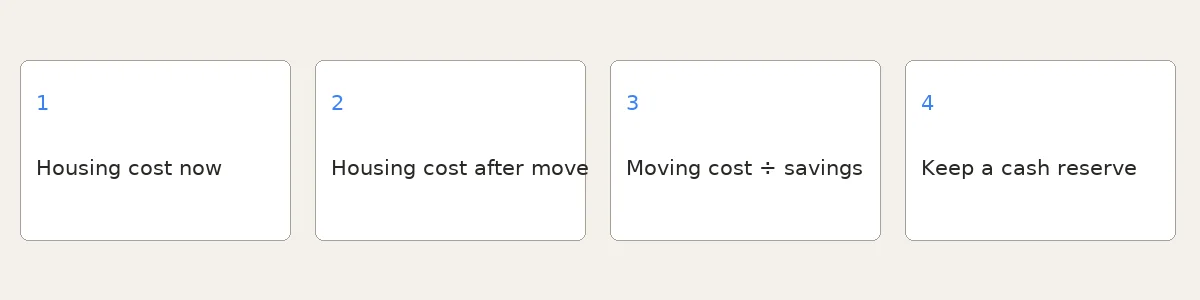
Retirement move budget sequence; use documented expenses rather than assumed savings.
If your projected saving is zero or negative, do not force a break-even result. The move may still improve accessibility or family support, but recognize that you are paying for that benefit. Compare selling estimates with the closing-cost calculator; it is a starting point, not your final settlement statement.
How home-sale taxes work after retirement
Retirement does not create a special federal home-sale exclusion. Eligibility depends on the ownership, use and other tests described in IRS Publication 523.
Generally, you must have owned and used the property as your main home for at least two years during the five years ending on the sale date. The maximum exclusion is generally $250,000 for a qualifying individual or $500,000 for qualifying married taxpayers filing jointly. The joint-return requirements are not identical for each spouse, so review them rather than assuming marriage doubles every exclusion.
Sale proceeds, equity and taxable gain are different numbers. Mortgage payoff reduces the money you receive but does not itself reduce taxable gain. Gain generally starts with the amount realized after eligible selling expenses minus adjusted basis. Keep purchase records and qualifying improvement receipts. A past rental period, depreciation or an earlier excluded sale can change the result. Ask your tax professional about reporting, including Form 1099-S, even if you expect no taxable gain.
The maximum exclusion is generally $250,000 for a qualifying individual or $500,000 for qualifying married taxpayers filing jointly.
Check benefits before treating proceeds as spending money
A home sale can affect means-tested assistance differently from Social Security retirement benefits. Check the program you actually receive before moving proceeds into another account.
For Supplemental Security Income, SSA explains that the home you live in is generally excluded from resources, while other property and money may count. Its SSI resources guide describes the $2,000 individual and $3,000 couple resource limits. Replacement-home proceeds have specific rules; ask SSA how they apply to your purchase schedule. Do not confuse SSI with regular Social Security retirement payments.
A taxable gain can also affect income used for Medicare premiums. SSA's Medicare premiums guidance explains income-related monthly adjustment amounts, commonly called IRMAA. Do not assume the entire sale price counts as income or that an excluded gain raises premiums. Ask your adviser to model the taxable portion and the relevant tax year before you sign.
Choose a retirement sale date around your next home
Your closing date should fit confirmed housing and funds availability, not an optimistic moving plan. Allow for inspections, title work, debt payoff and the time needed to receive proceeds.
If buying, ask your lender whether retirement income documentation changes your approval. If renting, obtain the lease terms and move-in date first. If you need proceeds to secure the next home, compare an extended closing with temporary housing. A post-closing occupancy arrangement requires a written agreement covering possession, insurance, payment and responsibilities; it is not automatic.
A home equity conversion mortgage adds a payoff step. CFPB explains that selling a home with a reverse mortgage requires repayment of the HECM balance, interest and fees. Get a written payoff rather than subtracting the original borrowed amount. Our reverse-mortgage sale guide covers that separate issue.
Compare a cash sale with listing after retirement
Compare written net proceeds and responsibilities for both paths. A faster, simpler sale can be useful, but a higher retail price may justify listing when you have time.
SilverCrest Estates can provide an as-is offer without requiring a pre-sale renovation. Ask your Seller Success Manager what the offer includes, which obligations remain yours and when possession transfers. Close in as little as 21 days depends on clear title, the transaction requirements and your agreed date; it is not a guarantee for every property.
For a fair comparison, include commissions if applicable, closing expenses, repairs, moving overlap, mortgage payoff and tax advice. Do not subtract a repair bill twice by counting both the actual repair and a buyer credit for the same defect. See our cash-buyer value comparison rather than deciding on headline price alone.
When a cash sale may not be your best option
Listing may be preferable when your home is move-in-ready, you have time for showings and maximizing equity is more important than speed. Staying may be better if your current costs are lower than the alternatives.
Get an independent listing estimate before choosing. Our cash offer versus listing guide shows the tradeoffs. If simplicity fits your plan, request a written cash offer and compare it without obligation.
Key takeaways
- Retirement does not automatically make a home sale tax-free.
- Use real housing bills, moving quotes and debt payoffs.
- Check SSI and Medicare implications with the relevant professionals.
- Confirm replacement housing and protect an emergency reserve.
- Choose the sale path that supports your budget and daily life.
Frequently asked questions
Does retirement make my home sale tax-free?
No. Retirement alone does not create a federal exclusion. IRS ownership, use and other requirements determine eligibility; your tax professional should check basis, depreciation and reporting.
Will selling my home affect SSI?
It can. Your principal residence is generally excluded from SSI resources, while proceeds may be treated differently. Ask SSA about replacement-home rules and your specific timing before selling.
Should I sell before choosing my next home?
Confirm your next housing plan first where possible. Verify availability, total costs and funds timing, then compare an extended closing or temporary housing rather than assuming an automatic rent-back.
Sources & further reading
Primary sources we consulted for this article. Rules vary by state and change over time — always confirm against the original source.
- 1Publication 523: Selling Your Home
Internal Revenue Service
Ownership and use tests, exclusion, basis and reporting.
- 2
- 3
- 4

About the author
Lisa Anderson
Seller Success Manager
Lisa Anderson works with the SilverCrest Estates acquisitions team, helping homeowners across 50+ US markets understand their options and close on their own timeline.
Disclaimer: This article is for general information only and is not legal, tax, or financial advice. Real estate rules vary by state and change over time. Consult a licensed attorney, tax professional, or financial advisor about your specific situation before acting.