Start here: this article is part of our seller questions collection. For the full picture, read our complete guide, Can You Sell a House With a Mortgage? Everything You Need to Know.
Quick answer: A 1099-S sale of home report shows the transaction, not necessarily taxable profit. The IRS requires reporting when you receive the form, even if the gain is excluded. SilverCrest Estates recommends checking three separate figures: gross proceeds, cash after closing deductions, and gain after eligible selling expenses and adjusted basis.
| Figure | What it answers |
|---|---|
| Gross proceeds | What amount was reported for the sale? |
| Net cash | What reached your account after closing? |
| Taxable gain | What remains after basis and applicable exclusions? |
What a 1099-S sale of home form means
Form 1099-S is an information return reporting a real estate transaction. It is not a tax bill and does not establish your profit by itself.
A reporting person, often connected with the closing, supplies transaction information to the IRS and the seller. Compare the taxpayer name, identification details, property description, closing date and proceeds with your closing records. Store the form securely; it includes sensitive financial information. Do not send an unredacted copy to an unfamiliar person who says they can reduce your tax.
The IRS instructions for Form 1099-S explain who reports and when particular exceptions apply. Not every main-home sale produces the same paperwork. Receiving no form is not proof that a sale is tax-free, and receiving one is not proof that tax is owed.
When a reported home sale belongs on your return
If you receive Form 1099-S, the IRS says you must report the sale even when you have no taxable gain. Reporting and paying tax are different questions.
The IRS home-sale guidance makes that distinction explicit. Some qualifying owners can exclude gain, but the transaction still needs to be reported when the form was issued. Other circumstances require reporting even without the form. Read the reporting section of the current Publication 523 before deciding what your return needs.
Do not assume that living in the home for a long time resolves every condition. Rental use, depreciation, previous exclusions, joint ownership and changes in marital status can affect the analysis. Our home-sale capital-gains guide covers eligibility; this checklist focuses on the documents arriving after the sale.
Who issues 1099-S for sale of home?
The reporting person follows the IRS transaction-reporting rules. Look at the filer information on your form rather than assuming the buyer is responsible.
If you did not receive a form and need to establish whether one was issued, contact the settlement professional through your existing closing records. Ask which person handled reporting and whether a certification or reporting exception applied. Keep that response with the settlement statement instead of relying on a verbal explanation months later.
Separate sale price, net cash and gain
These three numbers often differ substantially. Paying off a mortgage reduces the cash you receive but does not itself reduce the gain calculation.
Start with the settlement statement. Identify the gross sale amount, mortgage payoff, eligible selling expenses and other adjustments. Then find the purchase and improvement records needed to establish adjusted basis. Publication 523 provides worksheets; a bank deposit alone cannot replace them.
Worked example: why the deposit is not the profit
The following figures are examples, not typical fees, personal tax advice or SilverCrest results. Assume a $300,000 sale, $18,000 in eligible selling expenses, $180,000 adjusted basis and a $140,000 mortgage payoff.
The example gain before any exclusion is $102,000: $300,000 minus $18,000 minus $180,000. Cash after those selling costs and the payoff is $142,000. Neither the $300,000 sale amount nor the $142,000 deposit is automatically the taxable gain. Other settlement adjustments could change cash further.
The applicable exclusion comes after identifying gain. Do not subtract the mortgage twice or treat all repairs as basis improvements. The IRS explains which costs qualify. Use the closing-cost calculator to organize cash separately from the tax worksheet.
Form 1099-S is an information return reporting a real estate transaction.
Build a home-sale reporting file
A compact file makes the return easier to prepare and corrections easier to support. Gather records while the closing details are still fresh.
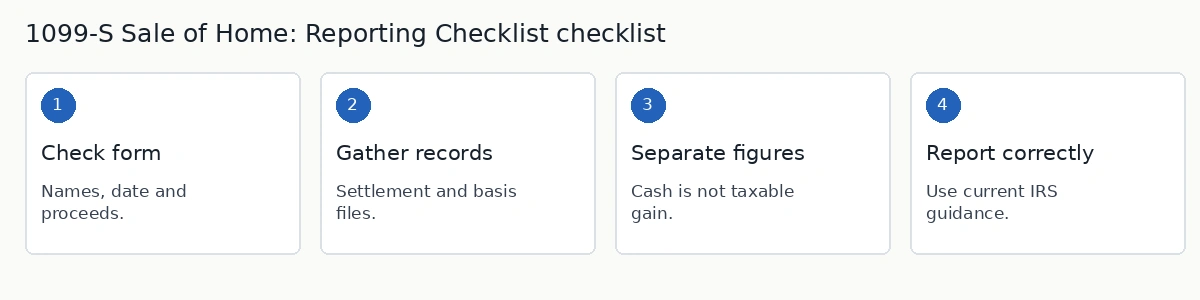
1099-S Sale of Home: Reporting Checklist checklist
- 1
Check form
Names, date and proceeds.
- 2
Gather records
Settlement and basis files.
- 3
Separate figures
Cash is not taxable gain.
- 4
Report correctly
Use current IRS guidance.
Confirm the records before making a sale decision.
Include the final settlement statement, Form 1099-S, the original purchase statement, capital-improvement receipts, records of relevant credits or subsidies, and dates of ownership and residence. If the home was rented, include depreciation records. If it was inherited, use the inherited-property tax guide to identify the different basis records.
Create a short index naming each document and its date. Preserve legible copies and the originals you already have. Separate estimates from receipts so an unsupported estimate does not accidentally become a reported cost. A roof invoice, maintenance receipt and mortgage payment are not interchangeable entries.
Correct errors with the reporting person
An incorrect name, closing date or proceeds figure should be investigated against the signed closing documents. Do not silently rewrite the form yourself.
Use a trusted contact from the completed transaction, explain the discrepancy, and request the reporting person’s correction process. Keep the original, any corrected version, and the written explanation. If several people owned the property, clarify what the form reports for each seller; do not assume equal ownership or equal reporting merely because relatives divided the deposit that way.
Tax-return due dates still matter during a correction. Consult current IRS filing instructions about your situation rather than waiting indefinitely for a response. If someone offers to amend a form for a fee, first verify that they are the actual reporting person.
A loss on your main home is different
The IRS says a loss from selling your personal main home is not deductible. A smaller closing deposit does not establish that deductible loss anyway.
For example, a large remaining mortgage can leave very little cash even when the sale creates a gain over adjusted basis. Conversely, a paid-off home can deliver substantial cash while the sale produces no taxable gain after an applicable exclusion. Keep the loan balance and tax basis on separate lines throughout your records.
When a cash sale may not be your best option
A reporting obligation is not a reason to accept a lower offer. Cash and financed transactions both require accurate closing and tax records.
If the home is ready to list and you have time, a listing may produce the better net outcome. Compare cash offers with listing using real offers and expenses, not a promise that one payment method avoids taxes. No buyer should promise a tax-free sale without examining the actual rules and facts.
Key takeaways
- Form 1099-S reports a sale rather than a tax bill.
- Receiving it means the sale must be reported, even when gain is excluded.
- Gross proceeds, net cash and taxable gain answer different questions.
- Mortgage payoff affects cash, not basis by itself.
- Match the form to closing records and retain corrections.
The bottom line
Before filing, organize the form, settlement statement and basis records as one file. The closing-day guide explains the documents you receive, while the relocation hub covers the move itself. If you are planning another property sale, request a written cash offer and compare net proceeds before choosing a path.
Frequently asked questions
Do I have to report a home sale if I receive Form 1099-S?
Yes. The IRS says a sale reported on Form 1099-S must be reported on your return even if you qualify to exclude all of the gain. Reporting the transaction does not itself mean you owe tax.
Is the amount on Form 1099-S my taxable profit?
No. Gross proceeds are not the cash deposited after payoff and costs, and they are not taxable gain. Calculate gain using the applicable selling-expense and adjusted-basis rules in IRS Publication 523.
What if my Form 1099-S has an error?
Contact the reporting person shown on the form and compare it with the signed settlement statement. Ask for a corrected form when appropriate, retain the correspondence, and use current IRS guidance for filing.
Sources & further reading
Primary sources we consulted for this article. Rules vary by state and change over time — always confirm against the original source.
- 1Tax considerations when selling a home
Internal Revenue Service
Receiving Form 1099-S requires reporting even when gain is fully excluded.
- 2Publication 523: Selling Your Home
Internal Revenue Service
Basis, selling expenses, exclusions and reporting instructions.
- 3Instructions for Form 1099-S
Internal Revenue Service
Gross proceeds and the reporting person’s responsibilities.

About the author
Michael Thompson
Property Specialist
Michael Thompson works with the SilverCrest Estates acquisitions team, helping homeowners across 50+ US markets understand their options and close on their own timeline.
Disclaimer: This article is for general information only and is not legal, tax, or financial advice. Real estate rules vary by state and change over time. Consult a licensed attorney, tax professional, or financial advisor about your specific situation before acting.