
Start here: this article is part of our seller questions collection. For the full picture, read our complete guide, Can You Sell a House With a Mortgage? Everything You Need to Know.
Quick answer: Selling a house while on SSI can change countable resources. SSA conditionally excludes proceeds intended and used for another excluded home within three full calendar months. SilverCrest Estates recommends confirming eligibility with SSA before setting dates, documenting when funds arrive, and preserving purchase records. This rule is not a general exemption for every home sale.
| Before deciding | What to establish |
|---|---|
| Benefit type | SSI rather than retirement benefits alone |
| Current home | Whether the home exclusion applies |
| Proceeds | Receipt date and intended use |
| Replacement | Qualifying purchase and supporting records |
Start with the correct benefit program
SSI is a needs-based program with resource rules. Do not substitute a general answer about Social Security retirement for an SSI proceeds question.
A person may receive more than one benefit, so check the actual notices and ask SSA which rules apply. This article addresses SSI resources after selling an excluded home. It does not decide Medicare, Medicaid, disability-insurance or retirement eligibility for you. Those programs and state assistance can have separate requirements.
The SSA resources-limits guidance lists countable-resource limits of $2,000 for an individual and $3,000 for a couple. Those are limits on countable resources, not a statement that everyone must sell a house worth more than those amounts. Exclusions matter.
The home and the sale money are different resources
An excluded principal home is not treated the same way as unrestricted cash after a sale. Confirm the home’s status before assuming the proceeds exclusion applies.
SSA’s home-exclusion guidance says an individual’s home is an excluded resource regardless of value. It also addresses land, residence and situations involving a move. An investment property, a former residence and the current home do not automatically receive identical treatment.
If you have already moved out, tell SSA when and why and whether you intend to return. The residence rules include specific exceptions. Do not assume that keeping the address on a bank statement proves the house remains excluded. Gather the facts SSA needs rather than trying to label the property yourself.
How replacement-home proceeds can remain excluded
SSA provides a conditional exclusion when proceeds from an excluded home are intended and used to buy another excluded home within the allowed period. Both the plan and the timely use matter.
The current POMS SI 01130.110 supplies the rule. It is not permission to retain any amount indefinitely, nor a promise that every expense during a move qualifies. Keep the replacement-home plan and the documents supporting actual use.
Ask SSA how your purchase contract, deposits and related costs fit the rule. POMS explains that using proceeds includes obligating them by contract as well as paying them out. That does not mean a casual intention or conversation is a qualifying obligation. Present the actual agreement and ask for application to your facts.
Does three full calendar months mean 90 days?
No. SSA defines the period by calendar months rather than a fixed number of days. Count from the receipt month using the official rule.
The deadline is the end of the last day of the third month after the month in which proceeds are received. For example, if funds arrive January 10, the three full calendar months are February, March and April, and the illustrative deadline is April 30. A different receipt month produces a different date.
This is a rule illustration, not a finding about your eligibility. Establish when you actually received the proceeds; a proposed contract date or closing appointment may not answer that. Do not schedule a replacement based on an assumed wire date without confirmation.
For example, if funds arrive January 10, the three full calendar months are February, March and April, and the illustrative deadline is April 30.
Map the sale and replacement in one calendar
A written calendar makes the timing visible before you accept an offer. The safest plan includes room for delays rather than relying on the final available day.
Selling a House While on SSI: Proceeds Rules checklist
- 1
Confirm benefit
SSI is needs-based.
- 2
Record receipt
Use actual proceeds date.
- 3
Plan replacement
Check eligible home uses.
- 4
Keep evidence
Ask SSA about unused funds.
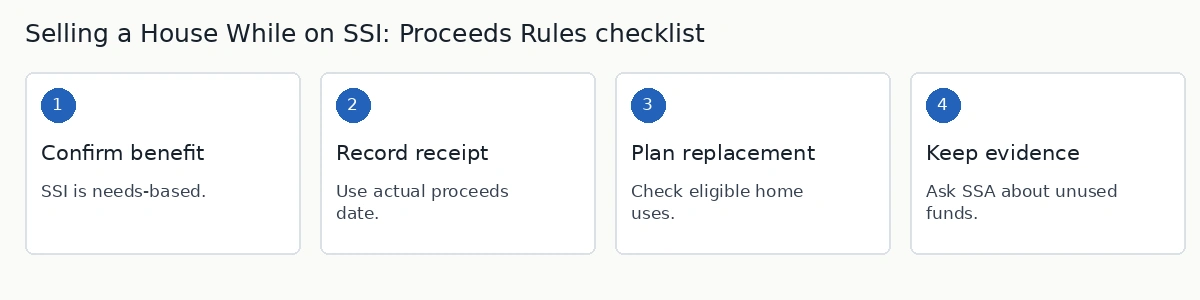
Confirm the records before making a sale decision.
List the proposed sale, expected fund receipt, replacement contract, deposit dates, closing and possession. Ask the replacement seller and closing professional what could delay the purchase. Keep the benefits deadline separate from the buyer’s preferred closing date and from the moving company’s availability.
Our selling while buying another home guide addresses the transaction coordination. It does not replace an SSI eligibility determination. A faster sale could start the proceeds period earlier, so speed is not automatically the best choice for a replacement-home plan.
Keep a proceeds file rather than relying on memory
SSA’s rule depends on facts you can document. Save evidence of receipt, intended use and purchase obligations together.
Include the sale settlement statement, account receipt, replacement purchase contract, deposit receipts and eligible-expense records. Keep notes of SSA contacts and copies of notices. Mark estimates clearly and retain dated versions when the plan changes.
A dedicated record of the proceeds can make the money easier to trace, but opening another account does not itself create an exclusion. Do not hide money, transfer it informally to relatives, or assume spending it on unrelated needs preserves the same treatment. Ask SSA before a gift or changed plan, since other resource rules may also matter.
What if the replacement is delayed or cancelled?
Unused proceeds can create a benefits problem, including retroactive treatment. Contact SSA promptly when your plan changes rather than waiting until the period ends.
POMS says the exclusion of unused lump-sum funds is revoked retroactively to their receipt when they are not used timely. It also addresses installment arrangements separately. Do not apply a simple lump-sum example to a seller-financed agreement without checking the installment provisions.
If the purchase falls through, keep the cancellation and returned-deposit records. Explain how much remains unused and whether a different purchase is possible. A buyer’s delay, a financing refusal or a title issue is not something to omit because it was outside your control.
Downsizing to a rental needs a different answer
Renting after the sale is not automatically buying another excluded home. The replacement-home proceeds rule should not be stretched to fit every housing move.
If you plan to rent, move in with family or enter a care setting, explain that exact plan to SSA before selling. Review the downsizing guide for housing decisions and the retirement guide for broader planning, but use SSA’s current rules for SSI.
When a cash sale may not be your best option
A rapid closing may be unhelpful when the replacement purchase is not ready. Choose a sale schedule that fits both housing and benefits requirements.
A ready-to-list home with time to market may bring more money, too. Compare cash offers with listing, and never accept a buyer’s claim that their payment method guarantees continued SSI. Neither a cash buyer nor this article decides benefit eligibility.
Key takeaways
- Verify SSI rather than relying on retirement-benefit advice.
- Excluded-home status and sale proceeds are separate questions.
- The replacement period is three full calendar months, not 90 days.
- Preserve receipt, contract and purchase-use records.
- Tell SSA promptly about unused funds or a changed plan.
The bottom line
Ask SSA to apply the current proceeds rules to your actual housing plan before choosing dates. Browse the senior-transition hub and request a written cash offer only as one option to compare. SilverCrest Estates can close in as little as 21 days when requirements allow; the earliest possible date is not always the right one.
Frequently asked questions
Can I sell my home while receiving SSI?
Yes, but you should establish how proceeds will be treated before choosing dates. SSA has a conditional exclusion for proceeds used to buy another excluded home within three full calendar months, not a blanket exemption for every sale.
Is the replacement-home deadline exactly 90 days?
No. SSA defines it using three full calendar months. The deadline is the end of the third month after the receipt month. For example, proceeds received during January have an illustrative deadline of April 30.
What happens if replacement-home proceeds are not used in time?
SSA’s POMS says the exclusion of unused lump-sum funds is revoked retroactively to receipt. Ask SSA to apply the rule to your documents, report changes, and do not assume moving money to another account makes it excluded.
Sources & further reading
Primary sources we consulted for this article. Rules vary by state and change over time — always confirm against the original source.
- 1POMS SI 01130.110: Home replacement funds
Social Security Administration
Conditions, full-calendar-month timing and retroactive treatment of unused funds.
- 2POMS SI 01130.100: Home exclusion
Social Security Administration
The principal-home exclusion and changes in residence.
- 3POMS SI 01110.003: Resources limits
Social Security Administration
SSI countable-resource limits of $2,000 individual and $3,000 couple.

About the author
Lisa Anderson
Real Estate Advisor
Lisa Anderson works with the SilverCrest Estates acquisitions team, helping homeowners across 50+ US markets understand their options and close on their own timeline.
Disclaimer: This article is for general information only and is not legal, tax, or financial advice. Real estate rules vary by state and change over time. Consult a licensed attorney, tax professional, or financial advisor about your specific situation before acting.