
Start here: this article is part of our seller questions collection. For the full picture, read our complete guide, Can You Sell a House With a Mortgage? Everything You Need to Know.
Quick answer: Medicaid estate recovery on a house means the state may claim repayment from a deceased person's estate for certain benefits received at 55 or older, and the home is often the largest asset. SilverCrest Estates suggests confirming whether a spouse or protected child delays the claim, getting the exact amount from the state recovery unit, and paying it from sale proceeds at closing.
| Fact | Effect on recovery |
|---|---|
| Benefits received at 55 or older | Recovery generally required |
| Surviving spouse | Recovery delayed |
| Child under 21, blind or disabled | Recovery delayed |
| Undue hardship | Waiver may be available |
What estate recovery is
Estate recovery is a federal requirement that states seek repayment of certain Medicaid costs from a recipient's estate after death. The house is usually what is left.
The federal rule is in 42 U.S.C. 1396p. For a person who was 55 or older when receiving benefits, the state must seek recovery for nursing facility services, home and community-based services, and related hospital and prescription drug services, and may choose to recover for other Medicaid costs. The CMS estate recovery overview summarizes the program. States also recover from people who were permanently institutionalized, regardless of age.
Who is protected
Federal law delays or limits recovery in several family situations. Check these before assuming the house must pay the claim.
Under the same statute, the state may recover only after the death of a surviving spouse, and only when there is no surviving child under 21 or a child who is blind or permanently disabled. States must also have hardship waiver procedures. Some states add protections for a sibling or adult child who lived in the home and provided care, tied to the separate rules on liens and transfers.
Liens during life
Some states place a lien on the home while the Medicaid recipient is alive and permanently in a facility. That lien shows up in a title search.
The statute allows a lien in limited cases when the person is permanently institutionalized and is not expected to return home, but not when a spouse, a child under 21, a blind or disabled child, or certain siblings live there. If you are selling a parent's house while they are in care, the title company will ask the state for a payoff on any recorded lien. Our guide to selling a parent's house for assisted living covers the move itself.
Selling during life versus after death
Timing changes the math. Talk to the state Medicaid office before you list.
Selling during life
Selling the house converts an exempt home into cash, which can affect eligibility. Proceeds may need to be spent on care before Medicaid resumes. If an agent under a power of attorney is signing, our power of attorney sale guide explains the paperwork. Benefits such as SSI have their own resource limits, covered in our SSI home sale guide.
Selling after death
After death, the personal representative usually sells the house and pays creditors, including the state's recovery claim, from proceeds. Our guide to selling a house in probate explains how court approval and creditor notice work. States differ on whether they recover only from the probate estate or from a broader estate that can include joint or trust property.
How to get the claim amount
The state recovery unit issues a written claim. Request it early, because it can take weeks.
Send the request with the death certificate, the recipient's Medicaid number if known, and the personal representative's letters. Ask for an itemized statement of the services claimed. Check that the dates match periods when your parent was actually 55 or older and receiving covered services.
Under the same statute, the state may recover only after the death of a surviving spouse, and only when there is no surviving child under 21 or a child who is blind or permanently disabled.
Worked example: a parent's house after care
These numbers are an example only, not a SilverCrest Estates case. A widowed mother received three years of nursing home care. After she dies, her house is worth $210,000 with no mortgage. The state's itemized claim is $164,000. Two adult children inherit.
Medicaid estate recovery on a house: sale path
- 1
Confirm the age rule
Benefits at 55 or older.
- 2
Check deferrals
Spouse, minor or disabled child.
- 3
Get the claim amount
State recovery unit.
- 4
Settle at closing
Release recorded.
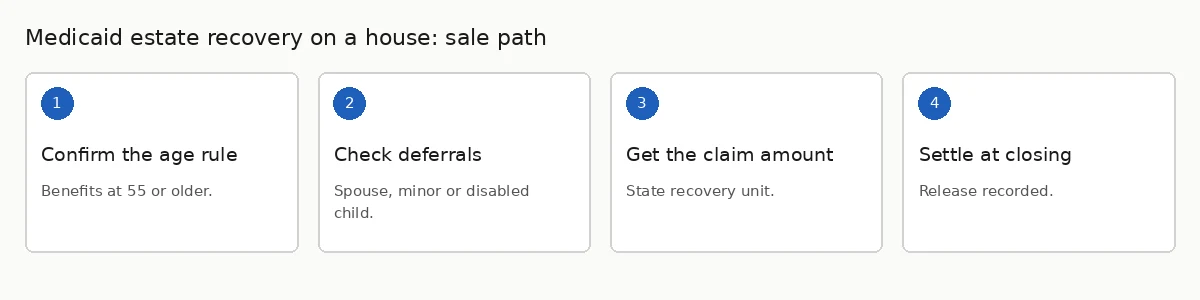
Check the protections before the claim.
There is no surviving spouse or protected child, so recovery applies. With an assumed $14,000 in selling and estate costs, about $196,000 remains. The state is paid $164,000 and records a release, leaving about $32,000 for the two children. Had one child lived in the home as a caregiver, the state's rules might have changed the result.
Asking for a hardship waiver
Every state must offer a hardship process, but the definitions differ. Apply within the deadline in the state's notice.
Common grounds include a family member who would lose their only home or whose income depends on the property. Gather proof of residence, income and the property's role before applying.
Common mistakes families make
Estate recovery surprises families most when they skip early questions. These are the mistakes we see heirs regret.
- Signing a sale contract before getting the claim. Without the itemized claim, you cannot know what the estate nets.
- Assuming the house is exempt because it was exempt during life. Being an exempt asset for eligibility is different from being protected from recovery after death.
- Missing the hardship deadline. State notices give a fixed period to apply.
- Transferring the house without advice. Gifts or transfers for less than value can trigger penalties under the same federal statute.
- Letting the house sit empty. Insurance, taxes and repairs reduce what is left for everyone.
The personal representative should keep a written record of every contact with the state recovery unit, including dates, names and copies of letters. That record helps if the claim amount is disputed.
When a cash sale may not be your best option
Estate recovery does not require a fast sale. If the house is in good condition and the estate can carry costs, listing may raise more for both the state and the family.
A cash sale helps when the house needs repairs, the heirs live far away, or carrying costs are eating the estate. Compare a cash offer with listing using the state's claim in both columns.
Key takeaways
- States must seek recovery for certain benefits received at 55 or older.
- A surviving spouse or a minor, blind or disabled child delays recovery.
- Some states record a lien during life for permanent facility residents.
- Request the itemized claim early and check the dates.
- Hardship waivers exist; follow the state's deadline.
The bottom line
Confirm the protections, get the itemized claim, and plan the sale so the release is recorded at closing. Visit the senior transitions hub for related guides, or request a written cash offer to compare; SilverCrest Estates can close in as little as 21 days when title is ready.
Frequently asked questions
Can Medicaid take my parent's house after they die?
Federal law requires states to seek recovery from the estates of people who received certain Medicaid benefits at 55 or older, and the house is often the main estate asset. Recovery is delayed while a surviving spouse lives or when there is a child under 21 or a blind or disabled child.
Can we sell the house before estate recovery?
Selling during life changes the asset from a house to cash, which may affect eligibility. After death, the estate can usually sell and pay the state's claim from proceeds.
Can the family ask for a hardship waiver?
Federal law requires states to have procedures to waive recovery when it would cause undue hardship. Each state defines hardship and the application process.
Sources & further reading
Primary sources we consulted for this article. Rules vary by state and change over time — always confirm against the original source.
- 142 U.S.C. 1396p
Cornell Legal Information Institute
Federal estate recovery, liens and hardship rules.
- 2
- 3

About the author
Emily Roberts
Property Acquisition Specialist
Emily Roberts works with the SilverCrest Estates acquisitions team, helping homeowners across 50+ US markets understand their options and close on their own timeline.
Disclaimer: This article is for general information only and is not legal, tax, or financial advice. Real estate rules vary by state and change over time. Consult a licensed attorney, tax professional, or financial advisor about your specific situation before acting.