Quick answer: You can sell a house in mortgage forbearance. The loan, including any paused or reduced payments, is normally paid off from sale proceeds at closing. SilverCrest Estates recommends four steps: request a written payoff statement, confirm how the forbearance amount is treated, compare your net against the price, and tell the servicer you are selling so no foreclosure step surprises you.
| Step | Why it matters |
|---|---|
| Written payoff statement | Shows the full amount due at closing |
| Forbearance terms | Paused payments are usually still owed |
| Net proceeds check | Confirms the sale covers the payoff |
| Servicer contact | Coordinates timing and loss mitigation |
What forbearance does and does not change
Forbearance temporarily pauses or reduces mortgage payments. It does not erase them.
The Consumer Financial Protection Bureau explains that forbearance is when the servicer lets you pause or reduce payments for a limited time, and that you will still need to repay the missed or reduced amounts. How you repay depends on your loan type and agreement: a lump sum, a repayment plan, a deferral to the end of the loan or a modification.
For a seller, the key point is simple. Whatever repayment method was offered, a sale normally ends the loan, and the full remaining balance becomes payable at closing.
Can I sell while still in forbearance?
Yes. Forbearance does not lock the house, and a sale is one of the ways forbearance ends.
You remain the owner and can sign a purchase contract. The title company will order a payoff from the servicer, and the mortgage lien is released after the payoff is received. If the forbearance amount was deferred to a separate subordinate lien, as some government-backed programs do, that second lien must be paid off too.
Does forbearance hurt the sale price?
No. Buyers do not take over your loan in a normal sale, so the forbearance does not appear in the buyer's purchase.
It does affect your net. Every paused payment, plus interest and any allowed fees, comes out of your proceeds.
Get a written payoff statement early
The payoff statement is the most important document in this sale. Request it in writing as soon as you are considering selling.
Under the federal rule at 12 CFR 1026.36(c)(3), a servicer generally must send an accurate payoff statement within seven business days of a written request, subject to limited exceptions. Ask for a figure good through your target closing date and a per-day amount after that date.
Check that the statement includes:
- Unpaid principal and interest.
- The forbearance or deferred amount, and any separate lien.
- Escrow shortages, if taxes or insurance were advanced.
- Fees, with an explanation for each.
A worked example: net proceeds after forbearance
These numbers are an example only. A seller in a nine-month forbearance has a $1,800 monthly payment, owes $205,000 in principal and accepts a $260,000 offer.
Selling a house in forbearance: closing path
- 1
Request payoff
Written figure through closing.
- 2
Add paused amounts
Forbearance still owed.
- 3
Check your net
Price minus payoff, costs.
- 4
Close and release
Lien cleared after payoff.
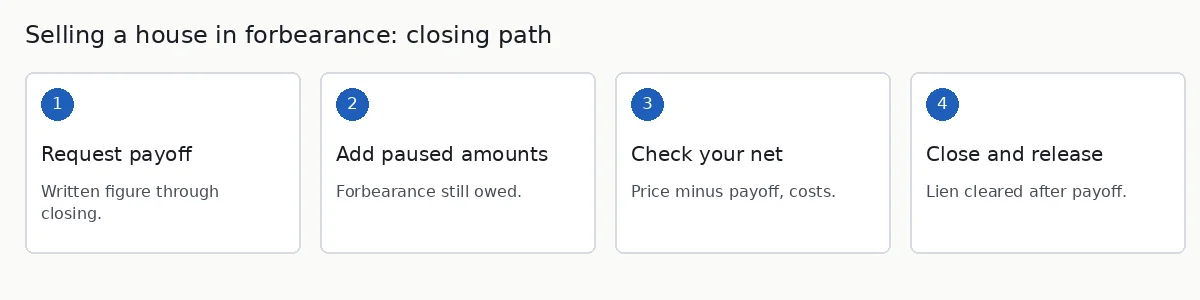
The sale pays the loan, including paused payments.
Nine paused payments total $16,200. Adding an assumed $2,400 escrow shortage brings the payoff to $223,600. After an assumed $6,000 in other closing charges, the example seller nets about $30,400. If the seller had expected to keep $46,600 by subtracting only the principal, the gap would have appeared at the settlement table.
A seller in a nine-month forbearance has a $1,800 monthly payment, owes $205,000 in principal and accepts a $260,000 offer.
If the sale will not cover the payoff
When the price does not cover the payoff and costs, the servicer has to agree before the sale can close. That is a short sale.
Ask the servicer about loss-mitigation options in writing. The CFPB's mortgage servicing rule at 12 CFR 1024.41 sets procedures servicers must follow when evaluating a complete loss-mitigation application, including certain protections against moving ahead with foreclosure while an application is pending. Options can include a short sale, a deed in lieu, a repayment plan or a loan modification.
A HUD-approved housing counselor can help you compare these options at no or low cost; the CFPB's housing counselor search lists agencies near you.
When forbearance ends before you close
Plan for the forbearance end date. Payments may restart while the sale is still pending.
If the forbearance period ends before closing, ask the servicer in writing what happens next: whether payments must resume, whether an extension is available and whether a short repayment window applies. Missing payments after forbearance ends can lead to delinquency and, eventually, foreclosure steps. Our guide to selling a house behind on mortgage payments explains that situation, and the how to avoid foreclosure guide covers broader options.
Tell the servicer you are selling
A short written note with your contract date and expected closing date helps. Keep a copy.
Some servicers will pause certain steps or extend a review when a signed contract is in place, but none are required to do so in every case. Clear communication prevents avoidable surprises.
Credit reporting and your next home
Selling ends the loan, but it does not rewrite the payment history. Plan your next housing step with that in mind.
Payments missed outside an approved forbearance can be reported as late. Ask the servicer how the account will be reported once the payoff is received, and keep the final payoff letter and the recorded lien release. If you plan to buy again or rent soon after closing, a future lender or landlord may ask for those documents. Pull your free credit reports a few weeks after closing to confirm the mortgage shows as paid in full, and dispute any error with the credit bureau in writing.
Other liens and charges to check
The mortgage is not always the only claim. Look at the full title report.
A home equity line, unpaid property taxes, HOA dues or judgment liens also come out of proceeds. Our guides to selling with a home equity loan and selling with a lien explain those payoffs.
When a cash sale may not be your best option
Forbearance alone does not mean you need a cash buyer. If you have time and the home shows well, listing may net more.
A cash sale can help when the forbearance end date is near, the home needs repairs, or you want a fixed closing date that matches a payoff deadline. Compare cash offers with listing using the full payoff, not just the principal balance.
Key takeaways
- Forbearance pauses payments but does not cancel them.
- A sale normally pays the full loan, including forbearance amounts.
- Request a written payoff statement early.
- A price below the payoff needs servicer approval.
- Plan around the forbearance end date.
The bottom line
Use the full payoff to decide whether and how to sell. Visit the behind on payments hub for related guides, or request a written cash offer to compare your net; SilverCrest Estates can close in as little as 21 days when title and payoff are ready.
Frequently asked questions
Can you sell a house in forbearance?
Yes. Forbearance does not lock the house. A sale is one of the ways forbearance ends, and the loan, including paused or reduced payments, is normally paid off from sale proceeds at closing.
Do I have to repay forbearance when I sell?
Usually yes. Forbearance pauses or reduces payments but does not cancel them, so the paused amount, and any separate deferral lien, is typically included in the payoff at closing.
How fast must my servicer send a payoff statement?
Federal rules generally require a servicer to send an accurate payoff statement within seven business days of a written request, subject to limited exceptions. Ask for a figure good through your closing date.
Sources & further reading
Primary sources we consulted for this article. Rules vary by state and change over time — always confirm against the original source.
- 1What is mortgage forbearance?
Consumer Financial Protection Bureau
Forbearance pauses or reduces payments that must later be repaid.
- 212 CFR 1026.36 payoff statements
Consumer Financial Protection Bureau
Seven-business-day payoff statement requirement.
- 312 CFR 1024.41 loss mitigation
Consumer Financial Protection Bureau
Procedures for evaluating loss-mitigation applications.
- 4Find a housing counselor
Consumer Financial Protection Bureau
Search for HUD-approved counseling agencies.

About the author
Lisa Anderson
Homeowner Advocate
Lisa Anderson works with the SilverCrest Estates acquisitions team, helping homeowners across 50+ US markets understand their options and close on their own timeline.
Disclaimer: This article is for general information only and is not legal, tax, or financial advice. Real estate rules vary by state and change over time. Consult a licensed attorney, tax professional, or financial advisor about your specific situation before acting.