Start here: this article is part of our distressed sales collection. For the full picture, read our complete guide, Can You Sell a House With Foundation Problems? Your Complete Guide.
Quick answer: You can sell a house while behind on mortgage payments, because you own it until a foreclosure sale. Federal rules generally block the first foreclosure filing until you are more than 120 days late. Get a written payoff quote, talk to a HUD-approved counselor, and compare a listing, a loan workout and an as-is offer from SilverCrest Estates.
| Step | What to do |
|---|---|
| Count days late | Check your last statement |
| Payoff quote | Ask the servicer in writing |
| Counselor | Free HUD-approved help |
| Compare | Workout, listing or as-is sale |
Already have a foreclosure notice or sale date? Jump to what to do if foreclosure has started, and request a cash offer today so you have a written number to compare.
Selling a house behind on mortgage payments: how it works
Missing payments does not take away your right to sell. A sale simply pays the lender first at closing.
At closing, the title company asks the servicer for a payoff statement. That figure includes the remaining principal, unpaid interest, missed payments, late fees and any costs the servicer has added. The title company pays it from the sale proceeds, and whatever is left after selling costs goes to you.
That is why selling early often protects more equity than waiting. Every extra month adds interest, late fees and, once foreclosure starts, legal costs that come out of your share.
Can I sell my house if I am behind on mortgage payments?
Yes. You keep the right to sell until the foreclosure sale, and the payoff comes out of the proceeds.
The 120-day rule and what comes after
Federal rules give most homeowners at least four months before foreclosure can formally begin.
Under 12 CFR 1024.41(f), a mortgage servicer generally may not make the first notice or filing required to start a judicial or non-judicial foreclosure until the loan is more than 120 days delinquent. If you send a complete loss mitigation application before that first filing, the servicer usually must finish reviewing it before moving ahead.
After the first filing, state law takes over. Judicial states run foreclosure through the courts and often take longer; non-judicial states can move faster. Our guide on how to avoid foreclosure walks through those stages.
Get a payoff quote and your numbers
A written payoff quote tells you exactly what a sale must cover. Ask for it in writing.
Call the servicer and request a mortgage payoff statement good through a date about 30 days out. Ask separately for a reinstatement quote, which is the amount needed to bring the loan current without selling. Add any second mortgage, home equity line or tax lien, since those get paid at closing too.
Then estimate what the house would sell for as-is and after repairs. The gap between sale price and total payoff is your equity.
Talk to a HUD-approved counselor
A housing counselor can explain every option at no or low cost before you decide.
HUD's housing counselor search lists approved agencies by area. Counselors can help you apply for a loan modification or forbearance, review a short sale, and check whether selling is the right move. HUD's avoiding foreclosure page summarizes the main options.
Your options side by side
Most homeowners behind on payments choose between four paths. Each has a different effect on the house, your equity and your credit.
| Option | Keep the house? | Who it fits |
|---|---|---|
| Repayment plan or forbearance | Yes | Short, temporary hardship |
| Loan modification | Yes | Lasting income change, affordable new payment |
| Sale (listing or as-is) | No | Equity covers the payoff |
| Short sale or deed in lieu | No | Owe more than the home is worth |
A sale is the only path here where you keep the leftover equity in cash. A workout keeps the house but adds the missed amounts back into the loan in some form. Ask the servicer how each option would affect your monthly payment and your credit report, and get those answers in writing before you choose.
Call the servicer and request a mortgage payoff statement good through a date about 30 days out.
Decision tree: catch up, sell or short sale
Each path should end in a written number. Line them up side by side.
Behind on payments: first four steps
- 1
Days late
From your latest statement.
- 2
Payoff quote
Written, good for 30 days.
- 3
Counselor
Free HUD-approved review.
- 4
Compare exits
Workout, listing or as-is.
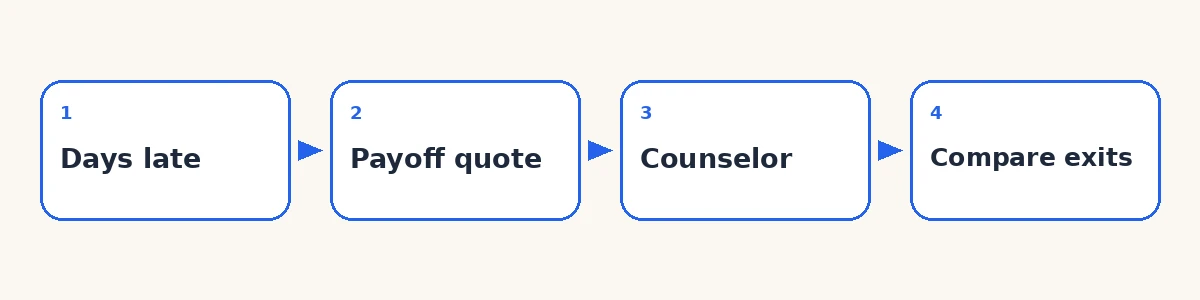
Know your days late and your payoff before you weigh any option.
- Hardship is temporary: ask about forbearance, a repayment plan or a modification and keep the house.
- Equity covers the payoff: compare a listing timeline with a written as-is offer.
- You owe more than it is worth: ask the servicer about a short sale or a deed in lieu.
- Foreclosure has a sale date: speed matters more than top price.
Worked example: listing versus an as-is sale
These figures are labeled examples, not typical prices or SilverCrest results. Replace each number with your own quotes and offers.
Suppose you are four months behind and the payoff is $198,000. Listing might bring $275,000 after $8,000 in repairs, with $17,000 in selling costs and five more months at $2,100 a month in added interest, fees and taxes. The example net is $41,500. An as-is offer of $255,000, with $3,000 in seller costs and one more month at $2,100, leaves $51,900.
In this example the faster sale nets more because waiting keeps adding to the payoff. With fewer months behind, listing could win.
If foreclosure has started
You can usually still sell after a foreclosure filing, up to the sale date. Move quickly and keep the servicer informed.
Tell the servicer you have a signed purchase contract and send it with a closing date. Ask whether it will postpone the sale to let the closing happen; servicers are not always required to agree, so get any answer in writing. A HUD-approved counselor or a local attorney can explain your state's specific deadlines.
When a cash sale may not be your best option
If your hardship is short-term and a modification or repayment plan fits your budget, keeping the house may be better.
If you have plenty of equity, months before any filing, and a move-in ready home, listing with an agent may net more. Compare cash offers with listing and read can you sell a house with a mortgage for how payoffs work in a normal sale.
Key takeaways
- You can sell while behind, up to the foreclosure sale.
- Federal rules generally bar a first filing before 120 days late.
- Get written payoff and reinstatement quotes.
- A HUD-approved counselor can review every option.
- Compare written net figures for workout, listing and as-is paths.
Related seller guide
If your payments are paused rather than missed, the forbearance payoff guide explains how paused amounts are added at closing.
Related seller guide
Once the lender sends formal notice, the clock changes. See what to do after a notice of default for the figures to request first.
The bottom line
Being behind on payments is a timing problem. Request a cash offer to see an as-is number next to your other options, or browse the behind on payments hub. SilverCrest Estates can close in as little as 21 days when speed protects your equity.
Frequently asked questions
Can I sell my house if I am behind on mortgage payments?
Yes. You still own the house until a foreclosure sale happens. A sale pays the lender from the proceeds at closing, including the missed payments, late fees and the remaining balance, and you keep any equity left over.
How long before foreclosure starts after missed payments?
Under 12 CFR 1024.41(f), a servicer generally cannot make the first foreclosure notice or filing until the loan is more than 120 days delinquent. State law then sets how long the rest of the foreclosure process takes.
What if I owe more than the house is worth?
A regular sale will not cover the loan, so ask the servicer about a short sale, where the lender agrees to accept less than the full balance. A HUD-approved housing counselor can help you compare that with other options.
Sources & further reading
Primary sources we consulted for this article. Rules vary by state and change over time — always confirm against the original source.
- 112 CFR § 1024.41 — Loss mitigation procedures
Legal Information Institute, Cornell Law School
Paragraph (f) bars the first foreclosure notice or filing until a loan is more than 120 days delinquent, with limited exceptions.
- 2Avoiding Foreclosure
U.S. Department of Housing and Urban Development
HUD overview of options for homeowners who are behind on payments.
- 3Find a Housing Counselor
U.S. Department of Housing and Urban Development
Free or low-cost HUD-approved counselors for homeowners behind on their mortgage.

About the author
Michael Thompson
Home Selling Expert
Michael Thompson works with the SilverCrest Estates acquisitions team, helping homeowners across 50+ US markets understand their options and close on their own timeline.
Disclaimer: This article is for general information only and is not legal, tax, or financial advice. Real estate rules vary by state and change over time. Consult a licensed attorney, tax professional, or financial advisor about your specific situation before acting.