Start here: this article is part of our seller questions collection. For the full picture, read our complete guide, Can You Sell a House With a Mortgage? Everything You Need to Know.
Quick answer: You can sell a house with a judgment lien, but the title company will normally require it to be paid, settled or released before closing. SilverCrest Estates suggests confirming the judgment and the payoff with interest, checking whether a homestead exemption protects the house, and asking the creditor for a written payoff or settlement before you accept an offer.
| Situation | Usual route |
|---|---|
| Valid judgment, enough equity | Pay from proceeds at closing |
| Valid judgment, thin equity | Negotiate a settlement and release |
| Judgment against someone else | Prove identity mismatch to title |
| Old or expired judgment | Show it lapsed or was not renewed |
What a judgment lien is
A judgment lien is a claim against property created when a court awards money to a creditor and the judgment is recorded or docketed where the house sits. It ties the debt to the real estate.
The Cornell Legal Information Institute explains that a judgment lien lets a creditor collect from the debtor's property. Our glossary entry on the judgment lien has the short definition, and our general lien guide compares it with tax, mortgage and contractor liens.
Common sources include unpaid credit cards, medical bills, personal loans, car deficiency balances and lawsuits after accidents. Many sellers learn about the lien only when the title search comes back.
Confirm the judgment before you pay anything
Start with the court record, not the collection letter. The recorded judgment, the docket and the payoff letter can tell different stories.
Pull a copy of the recorded abstract or certificate of judgment and the court docket. Then confirm five facts:
- The debtor's name and whether it is really you.
- The original amount, costs and the post-judgment interest rate.
- Payments already credited.
- The recording date in the county where the house sits.
- Whether the judgment was renewed when the statute required.
Name mix-ups are common. If the judgment belongs to someone with a similar name, the title company will usually accept a signed identity affidavit with your date of birth or other identifying details instead of a payoff.
How long the lien lasts
Duration depends on which court entered the judgment and the state's renewal rules. Some judgments quietly expire.
For federal judgments, 28 U.S.C. 3201 makes the lien effective for 20 years, and it may be renewed once for another 20 years if the creditor files a notice of renewal on time. State court judgments follow state statutes, which set their own lifespans, renewal filings and interest rates. A judgment that was never renewed may no longer bind the house, but get the title company to agree in writing before you rely on that.
Check homestead and exemption protections
Some states shield a primary residence from most judgment creditors. That protection can change who gets paid at closing.
Texas is the strongest example. Property Code chapter 41 exempts a qualifying homestead from seizure for most debts, with exceptions such as purchase money, taxes, home equity loans and work on the home. Florida and several other states also have broad homestead protections, while many states protect only a fixed dollar amount of equity. The Cornell overview of the homestead exemption explains the general idea.
Title companies still want the record cleared even when the house is protected. Expect to sign a homestead affidavit, and sometimes to obtain a release or court order, before the buyer's policy is issued. Our glossary page on the homestead exemption explains the term.
A seller has a $240,000 offer, a $150,000 mortgage payoff and an $18,500 credit card judgment from 2019 that has grown with interest to $23,000.
Four ways to clear a judgment lien
Choose the route that fits the facts. Paying a judgment you do not owe and fighting one you clearly owe both waste money and time.
1. Pay the full payoff at closing
If the judgment is valid and you have equity, paying from proceeds is simplest. The title company orders a written payoff and collects a recorded satisfaction.
Ask for the payoff good through your expected closing date, including daily interest.
2. Negotiate a settlement
Creditors often accept less when equity is thin or the debt is old. Get the reduced amount and the promise to record a release in writing before closing.
Lump-sum offers paid at closing are attractive to creditors because the money is certain. Keep the agreement in your closing file.
3. Prove the lien does not attach
Identity mismatches, expired judgments and homestead protection can all mean the lien does not bind the house. The title company decides what proof it needs.
4. Handle it inside bankruptcy
In bankruptcy, some judgment liens that impair an exemption can be avoided. Our bankruptcy sale guide explains how court approval affects a sale.
Worked example: an old credit card judgment
These numbers are an example only, not a SilverCrest Estates case. A seller has a $240,000 offer, a $150,000 mortgage payoff and an $18,500 credit card judgment from 2019 that has grown with interest to $23,000.
Selling a house with a judgment lien: clearing path
- 1
Confirm the judgment
Docket, amount, interest.
- 2
Check protections
Homestead and exemptions.
- 3
Price a payoff
Full, settled or partial.
- 4
Record the release
Title clears the sale.
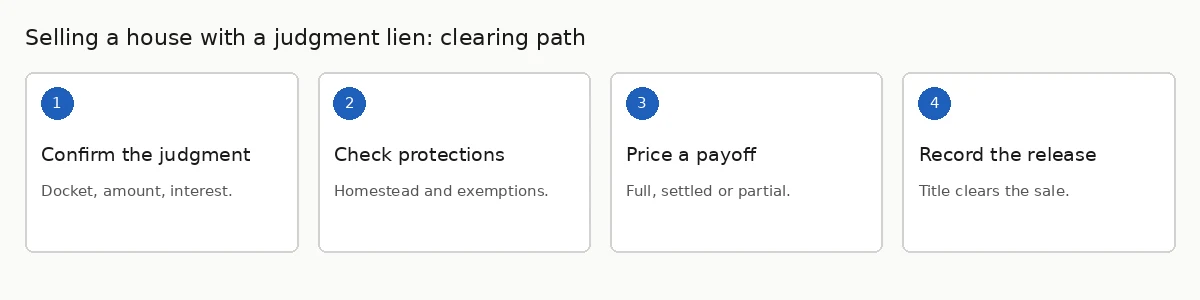
Confirm, protect, then pay or settle.
The seller's state offers no homestead protection above a small exemption. The creditor accepts $16,000 paid at closing for a recorded satisfaction. With an assumed $8,000 in other closing charges, the example seller nets about $66,000 instead of about $59,000 at the full payoff.
Other liens often come with it
A judgment lien rarely arrives alone. Check the full title report.
Unpaid property taxes, HOA dues and a pending lawsuit can each need their own payoff or release. Our guides to property taxes and a recorded lis pendens cover those steps.
Timing and the buyer
Most buyers will not wait months for a creditor dispute. Start the payoff request as soon as you decide to sell.
Creditors and their attorneys can take one to three weeks to issue a payoff letter. Ask the title company to order it early, and give the buyer a realistic closing date that leaves room for a settlement counteroffer.
When a cash sale may not be your best option
A judgment lien does not require a cash buyer. If you have plenty of equity and a house in good shape, listing may net more after the lien is paid.
A cash sale helps most when the lien is part of a broader money squeeze, repairs are heavy or you need a fixed date. Compare a cash offer with listing using the same payoff figures.
Key takeaways
- A recorded judgment can attach to your house and block closing.
- Confirm the debtor, amount, interest and renewal status first.
- Homestead laws may protect equity, but title still needs paperwork.
- Pay, settle, prove it does not attach, or address it in bankruptcy.
- Order payoffs early so the closing date holds.
The bottom line
Treat a judgment lien as a math and paperwork problem: confirm it, test the protections, then settle on the cheapest reliable release. Browse the liens and judgments hub, or request a written cash offer to compare; SilverCrest Estates can close in as little as 21 days when title is ready.
Frequently asked questions
Can I sell my house if there is a judgment lien on it?
Usually yes. The title company will normally require the judgment to be paid, settled, released or shown not to attach to the house before it insures the buyer, and payment from sale proceeds is common.
How long does a judgment lien last?
It depends on the court. A federal judgment lien generally lasts 20 years and can be renewed once for another 20 years under 28 U.S.C. 3201; state judgment liens follow state statutes with their own terms and renewals.
Can a creditor take my homestead with a judgment lien?
Some states protect a homestead from most judgment creditors. Texas, for example, exempts a qualifying homestead from seizure for most debts under Property Code chapter 41, but protection depends on state law and the type of debt.
Sources & further reading
Primary sources we consulted for this article. Rules vary by state and change over time — always confirm against the original source.
- 1Judgment lien
Cornell Legal Information Institute
Defines how a court judgment becomes a lien on property.
- 2
- 3
- 4

About the author
Jennifer Martinez
Real Estate Transaction Specialist
Jennifer Martinez works with the SilverCrest Estates acquisitions team, helping homeowners across 50+ US markets understand their options and close on their own timeline.
Disclaimer: This article is for general information only and is not legal, tax, or financial advice. Real estate rules vary by state and change over time. Consult a licensed attorney, tax professional, or financial advisor about your specific situation before acting.