Start here: this article is part of our seller questions collection. For the full picture, read our complete guide, Can You Sell a House With a Mortgage? Everything You Need to Know.
Quick answer: You can sell a house with a PACE loan, but most buyers' lenders will require the assessment to be paid off at closing because it sits ahead of the mortgage. SilverCrest Estates suggests finding the assessment on your property tax bill, getting a written payoff from the program administrator, and pricing your net proceeds with that payoff included before you accept an offer.
| Question | Typical answer |
|---|---|
| Where is it billed? | On the property tax bill |
| Who is paid first? | PACE usually ahead of the mortgage |
| Will a conventional lender accept it? | Usually only if paid off |
| Can a cash buyer take it on? | Sometimes, by agreement |
What a PACE loan is
PACE stands for Property Assessed Clean Energy. It finances energy, water or resilience upgrades and is repaid through a special assessment on the property tax bill.
The Fannie Mae Selling Guide describes PACE as loans made by localities for energy-related improvements that are generally repaid through the homeowner's real estate tax bill. Common projects include solar panels, heat pumps, roofs, windows and insulation. Because it is tied to the property rather than to you, it behaves differently from a normal loan when you sell.
Why PACE complicates a sale
The issue is lien priority. A PACE assessment usually jumps ahead of the existing mortgage, which lenders do not like.
Fannie Mae states that these loans typically have automatic first lien priority over previously recorded mortgages, and that its standard security instruments prohibit loans senior to the mortgage. In practice, a buyer financing with a conventional loan generally needs the PACE balance paid off before closing. FHA and VA rules have changed over the years, so the buyer's lender has the final word. The Cornell overview of liens explains how priority decides who gets paid first.
Federal rules for newer PACE loans
The Consumer Financial Protection Bureau finalized a rule applying Truth in Lending protections to residential PACE financing.
The CFPB's residential PACE rule applies disclosure and ability-to-repay requirements, linked to 12 CFR 1026.43, to PACE financing. It does not erase older assessments. For a seller, the practical point is unchanged: get the payoff and expect to clear it.
Step 1: find the assessment
Many sellers forget the PACE loan exists because it hides inside the tax bill. Look for a line labeled with the program name.
Check your latest property tax bill for a special assessment. The title search will also show the recorded assessment or lien. Write down the program name, administrator, annual payment and remaining term.
Step 2: get a written payoff
The administrator issues the payoff, not the county. Ask early.
Request a payoff good through your expected closing date. Ask whether it includes any prepayment charge, unpaid installments already on the current tax bill, and the administrator's release fee. Some programs prorate the current year's installment through the tax bill, which can create a double charge if not handled carefully on the closing statement.
Step 3: talk to the buyer's lender
Do not assume the assessment can stay. Ask before you sign.
When you get an offer, ask the buyer's lender in writing whether the PACE balance must be paid off. If the answer is yes, price the payoff into your net. A cash buyer may be able to take the house subject to the assessment, but you would agree on a lower price in exchange.
Worked example: solar and a heat pump
These numbers are an example only, not a SilverCrest Estates case. A homeowner financed $38,000 of solar panels and a heat pump through PACE. Four years later, the payoff is $31,500. The house sells for $410,000 with a $260,000 mortgage payoff.
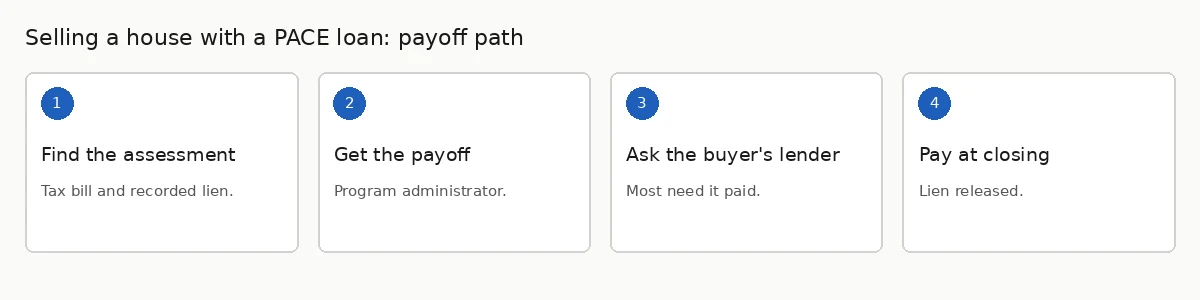
Selling a house with a PACE loan: payoff path
- 1
Find the assessment
Tax bill and recorded lien.
- 2
Get the payoff
Program administrator.
- 3
Ask the buyer's lender
Most need it paid.
- 4
Pay at closing
Lien released.
Know the payoff before you list.
With an assumed $28,000 in commissions and closing costs on a listed sale, the example seller nets about $90,500 after paying the PACE balance. If the seller had assumed the buyer would take over the assessment, the surprise at closing would have been $31,500.
A homeowner financed $38,000 of solar panels and a heat pump through PACE.
Solar panels and other upgrades
PACE often financed the same equipment buyers ask about. Have the documents ready.
Gather warranties, permits, monitoring access and any utility agreements. If your panels are leased or financed separately, see selling a house with solar panels. A second loan on the house works differently, as our home equity loan guide explains.
Disclose it early
Buyers and their lenders will see the assessment on the tax bill and the title report. Telling them first protects the deal.
State disclosure rules vary, and some states require specific PACE disclosures. Our seller disclosure guide covers the general framework.
Questions to ask the PACE administrator
The administrator holds the details that decide your closing numbers. Ask these in writing so the answers land in your file.
- What is the exact payoff, and through what date is it good?
- Is there a prepayment fee or a release recording fee?
- How much of the current tax year's installment has already been billed by the county?
- Will you send the lien release to the county recorder, and how long does it take?
- Can the assessment stay with the house if the buyer agrees, and what would the buyer need to sign?
Share the answers with your title company before you sign a purchase contract. A clear payoff letter avoids a last-minute change to your net.
Refinancing instead of selling
Sellers who are not sure they want to move sometimes look at a refinance first. The same priority rule applies.
A new conventional mortgage will usually require the PACE assessment to be paid off as part of the refinance. Ask the lender before applying, so the appraisal and payoff are planned together.
When a cash sale may not be your best option
A PACE balance does not by itself call for a cash sale. If your equity easily covers it, listing may net more.
A cash sale helps when equity is thin, the house still needs repairs the upgrades did not fix, or a buyer's lender keeps rejecting the assessment. Compare a cash offer with listing with the payoff included in both.
Key takeaways
- PACE is repaid on the tax bill and usually sits ahead of the mortgage.
- Most conventional lenders require payoff before closing.
- Get a written payoff from the program administrator early.
- Watch for the current year's installment on the closing statement.
- Disclose the assessment from the start.
The bottom line
Treat the PACE balance as a payoff you will likely make at closing, and price your net with it included. Visit the liens and judgments hub for related guides, or request a written cash offer to compare; SilverCrest Estates can close in as little as 21 days when title is ready.
Frequently asked questions
Can you sell a house with a PACE loan?
Yes. The assessment is attached to the property tax bill, so it either gets paid off at closing or, when the buyer's lender allows it, stays with the house. Many conventional lenders require payoff.
Why do lenders care about PACE loans?
Fannie Mae explains that PACE loans typically have automatic first lien priority over previously recorded mortgages, and its standard security instruments prohibit loans senior to the mortgage.
Does a PACE loan transfer to the buyer?
It can in principle, because it is repaid through property taxes, but a buyer using a conventional mortgage usually cannot close until it is paid, so most sellers pay it from proceeds.
Sources & further reading
Primary sources we consulted for this article. Rules vary by state and change over time — always confirm against the original source.
- 1Property Assessed Clean Energy Loans
Fannie Mae Selling Guide
PACE first-lien priority and eligibility.
- 2Residential PACE financing rule
Consumer Financial Protection Bureau
Federal Truth in Lending rule for PACE.
- 3
- 4

About the author
David Park
Senior Advisor
David Park works with the SilverCrest Estates acquisitions team, helping homeowners across 50+ US markets understand their options and close on their own timeline.
Disclaimer: This article is for general information only and is not legal, tax, or financial advice. Real estate rules vary by state and change over time. Consult a licensed attorney, tax professional, or financial advisor about your specific situation before acting.