Start here: this article is part of our selling your home collection. For the full picture, read our complete guide, How to Sell Your House Fast: The Complete Homeowner's Guide.
Quick answer: Selling a house with an encroachment usually works once the problem is defined on paper. Get a survey showing the encroachment, read the title commitment's exceptions, and decide whether to resolve, insure or disclose it. SilverCrest Estates can make an as-is offer, but cash does not move a fence or cure a title defect. Check four things: survey, title, resolution and offer terms.
| Item | What to confirm |
|---|---|
| Survey | Where the structure sits relative to the boundary |
| Title commitment | Whether it appears as an exception |
| Resolution | Removal, agreement, endorsement or disclosure |
| Offer terms | What the buyer requires before closing |
Selling a house with an encroachment: define it first
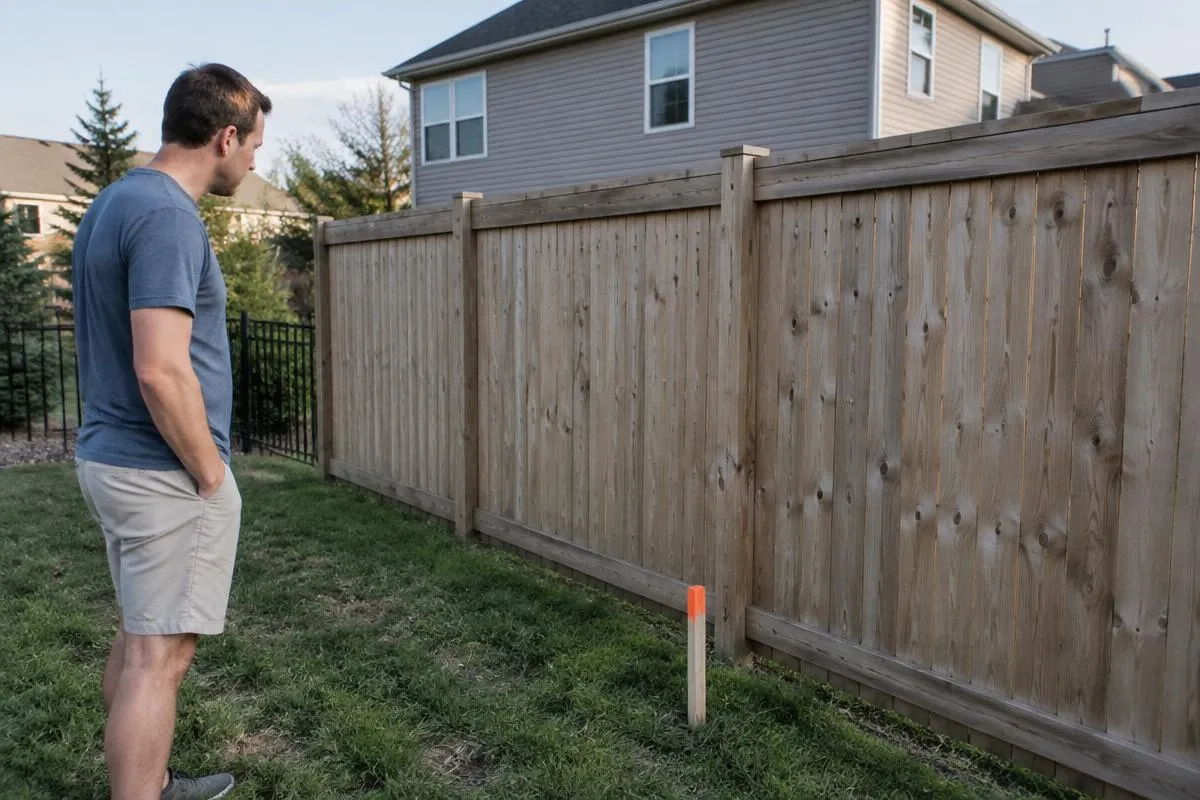
An encroachment is a structure or improvement that crosses a property line, such as a fence, shed, driveway edge, deck or roof overhang. It can run from your property onto a neighbor's, or from theirs onto yours.
Write down what crosses, which direction and roughly how far. A fence a few inches over the line is a different conversation from a garage that sits partly on the neighbor's lot. Separate what you can see from what you believe about ownership; a long-standing fence is not by itself proof of where the boundary lies.
The most reliable picture comes from a survey by a licensed land surveyor. If you already have one from your purchase, check whether it shows the structure in its current position. Improvements added later will not appear on an older survey.
Build a small file as you go: the survey, your deed, any recorded agreements with the neighbor, photos of the structure and dated notes of conversations. Label what is confirmed and what is still a question. Handing a buyer an organized file early usually shortens the back-and-forth later.
Read the title commitment before setting a closing date
The title commitment lists what the title company will not insure. An encroachment often shows up there, and that list drives what has to happen before closing.
The North Carolina Department of Insurance's title insurance guide explains that title insuring begins with a search of public records and emphasizes eliminating risk before a policy issues. Ask the title company three questions: Is the encroachment listed as an exception? Will it block the buyer's loan or policy? What would remove or insure over it?
The Texas Department of Insurance's title insurance FAQ notes that title insurance protects against losses from ownership problems that arose before purchase, and that buyer and seller may negotiate who pays the premium. Treat those as Texas-specific details and confirm your own state's practice.
Does title insurance cover an encroachment?
It depends on the policy, the survey and any endorsement. Many policies exclude matters an accurate survey would reveal unless the insurer has a survey or issues added coverage.
State rules differ. In Florida, Section 627.7842 provides that when a qualifying survey certified to the title insurer is completed within 90 days before closing, the policy may only except encroachments and boundary matters actually shown on that survey. That rule is specific to Florida. Elsewhere, read the commitment's exceptions and ask the title company what coverage is available.
Choose a resolution path that fits the facts
Most encroachments resolve one of four ways. The right choice depends on the structure, the neighbor and what the buyer and title company require.
Encroachment: paper before price
- 1
Survey
Locate the structure and boundary.
- 2
Title
Read the commitment's exceptions.
- 3
Resolve
Remove, agree, insure or disclose.
- 4
Compare
Weigh written offer terms.
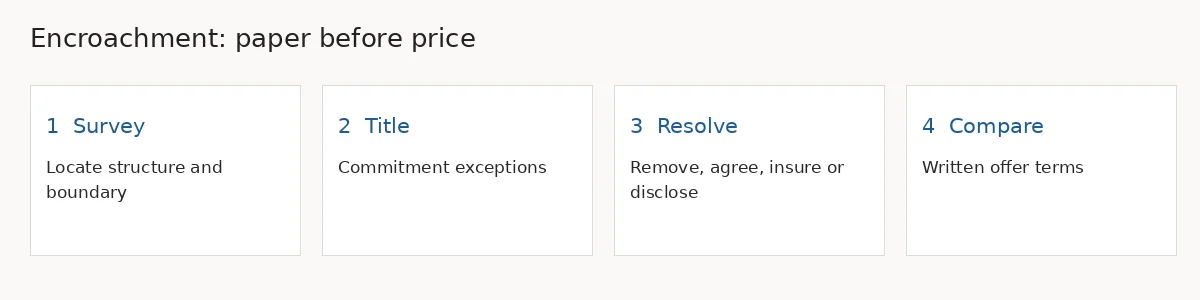
Resolve the paperwork question before negotiating the price.
- Remove or relocate: practical for a fence or shed you own. Get a written quote and keep before-and-after photos.
- Written agreement: a recorded boundary or encroachment agreement, or an easement, with the neighbor. Only the neighbor can sign for the neighbor.
- Title endorsement: some title companies can insure over certain encroachments for an added premium. Ask what is available.
- Disclose and price: some buyers accept a minor documented encroachment. Put the disclosure and any credit in writing.
The shared driveway guide covers a related access situation, and the liens guide explains other title items that can surface during the same review.
Suppose a listing offer is $340,000 with $21,000 in expected selling costs, a $1,200 updated survey and $3,800 to move a fence.
Work with the neighbor without overpromising
A cooperative neighbor can make the fix simple. But you cannot promise a buyer that a neighbor will sign anything until it is signed.
Start with a calm conversation and the survey in hand. Explain what the title company needs and offer to share costs if that is fair. If the neighbor agrees, have the document prepared, signed and recorded as the title company requires. Keep the timeline realistic in your purchase contract; a neighbor's travel or hesitation can push a closing date.
If the neighbor disputes the boundary, do not set a closing date that depends on resolving it quickly. A disputed boundary is a legal question; write down what you know, keep correspondence and let the title company tell you what it needs.
Compare offers using the actual conditions
There is no supported universal encroachment discount. Compare written offers, the cost of each resolution path and what each buyer needs before closing.
Ask every buyer whether the encroachment affects their offer, financing or title policy, and what happens if resolving it takes longer. A cash buyer avoids mortgage underwriting but still needs acceptable title to close. Our closing-day guide explains what has to be in place.
Worked example: removal versus an as-is sale
These figures are labeled examples, not typical prices or SilverCrest results. Replace them with your own quotes and offers.
Suppose a listing offer is $340,000 with $21,000 in expected selling costs, a $1,200 updated survey and $3,800 to move a fence. The example net is $314,000 before payoff. An as-is offer of $318,000 with $2,500 in seller costs leaves $315,500 before the same payoff.
The gap is small, so the decision turns on timing and certainty. Add carrying costs if fence removal or a neighbor agreement would delay closing. Use the closing-cost calculator to organize the figures.
When a cash sale may not be your best option
Listing may suit a home with a minor, documented encroachment that the title company will insure over, and a seller with time for market exposure. A small fence issue is not a reason to accept a steep reduction.
If the fix is cheap and the neighbor is cooperative, resolving it before listing may net more. Compare cash offers with listing and ask any buyer to explain how the encroachment affected their number.
Key takeaways
- Define the encroachment with a current survey.
- The title commitment's exceptions drive what must happen before closing.
- Title coverage rules vary by state and policy.
- Only the neighbor can sign a neighbor agreement.
- Compare written net proceeds and timing for each path.
The bottom line
An encroachment calls for a paper-first sale, not a guessed discount. Request a cash offer to compare an as-is option, or browse the liens and judgments hub. SilverCrest Estates can close in as little as 21 days when title and other requirements allow; choose a later date when you need more time.
Frequently asked questions
Can I sell a house with an encroachment?
Yes, many encroachments are handled during a normal sale. The title company decides whether to list it as an exception, require a fix or offer coverage, so get the survey and title commitment reviewed before agreeing to a closing date.
Does title insurance cover an encroachment?
It depends on the policy and its exceptions. Many policies exclude matters an accurate survey would show unless a survey was provided or an endorsement was issued. Read the exceptions in your title commitment and ask the title company directly.
Do I need a new survey to sell?
Not always. Lenders, title companies and some state rules decide when a new survey is needed. Ask the title company whether your existing survey is acceptable before ordering a new one, since requirements differ by transaction.
Sources & further reading
Primary sources we consulted for this article. Rules vary by state and change over time — always confirm against the original source.
- 1Title Insurance
North Carolina Department of Insurance
How a title search reviews public records before a policy issues.
- 2Florida Statutes § 627.7842, Policy exceptions
The Florida Senate
Survey within 90 days limits encroachment exceptions to matters shown on the survey.
- 3Title insurance FAQ
Texas Department of Insurance
What title insurance covers and who negotiates premium payment.

About the author
Jennifer Martinez
Real Estate Transaction Specialist
Jennifer Martinez works with the SilverCrest Estates acquisitions team, helping homeowners across 50+ US markets understand their options and close on their own timeline.
Disclaimer: This article is for general information only and is not legal, tax, or financial advice. Real estate rules vary by state and change over time. Consult a licensed attorney, tax professional, or financial advisor about your specific situation before acting.