Start here: this article is part of our seller questions collection. For the full picture, read our complete guide, Can You Sell a House With a Mortgage? Everything You Need to Know.
Quick answer: A tax lien sale sells the county's claim for unpaid property taxes, so you keep the house and can pay the debt off with interest. A tax deed sale sells the house itself, sometimes with a short window to buy it back. SilverCrest Estates finds the deadline that matters most is the redemption period, which ranges from months to several years by state.
| Tax lien sale | Tax deed sale | |
|---|---|---|
| What is sold | A certificate for the unpaid tax | The property |
| Who owns the house after | You, subject to the lien | The buyer, or you if you redeem |
| How you fix it | Pay the taxes, interest and costs | Redeem within any allowed window |
| Main risk | Certificate holder later seeks a deed | Losing ownership and equity |
General education, not legal advice.
Tax lien vs tax deed: the core difference
The difference is what changes hands at the sale. In a lien sale, an investor buys the right to collect your unpaid taxes plus interest. In a deed sale, a buyer receives a deed to the property.
Every state sets its own system, and some combine both. A lien sale gives you more time, because ownership does not change yet. A deed sale is closer to the end of the process, because the property has already been sold. The tax lien and tax deed glossary entries give short definitions; this guide covers what each means for a homeowner who wants to keep or sell.
How a tax lien sale works
When taxes go unpaid, a lien state sells the debt as a tax certificate. The buyer pays the county, and you then owe that buyer the taxes plus interest and costs set by state law.
Florida is a well-known example. Counties sell certificates on delinquent parcels, and the holder earns interest until the owner pays. Under Florida Statutes section 197.502, once two years have passed since April 1 of the year the certificate was issued, the holder may apply to the county tax collector for a tax deed. That application starts the path to an actual sale of the house.
Can you sell a house with a tax lien on it?
Yes. The certificate is paid off from the sale proceeds at closing, the same way a mortgage is. The title company orders a redemption or payoff amount from the tax collector and pays it at closing. Our guide to selling a house behind on property taxes covers the steps.
How a tax deed sale works
In a deed system, the property is sold at auction after a court judgment or administrative process. The buyer receives a deed, and your ownership ends unless state law gives you a right to redeem.
Texas is an example of a state that sells the property but allows redemption. Under Texas Tax Code section 34.21, an owner whose residence homestead was sold at a tax sale may redeem on or before the second anniversary of the date the buyer's deed is recorded. The owner pays the bid amount, recording fee and taxes the buyer paid, plus a 25 percent premium in the first year or 50 percent in the second. For most other property, the window is 180 days and the premium is capped at 25 percent.
Tax lien vs tax deed: where you are
- 1
Taxes unpaid
Penalties and interest add up.
- 2
Lien or suit
Certificate sold or case filed.
- 3
Deed sale
The property is auctioned.
- 4
Redemption
Window if state law allows.
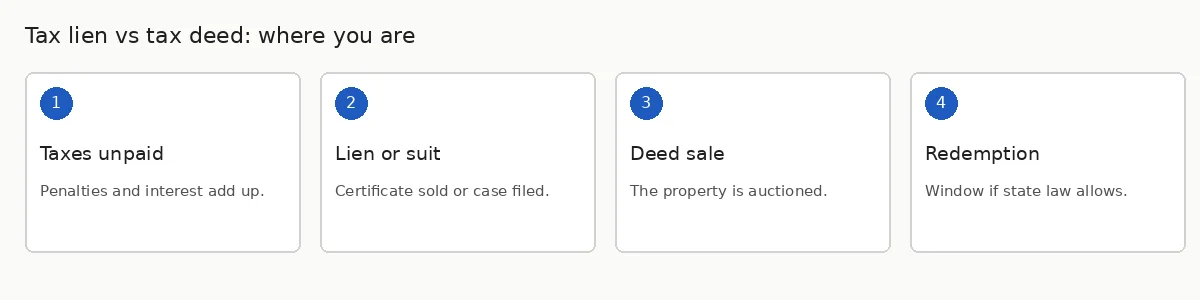
Find your stage, then the deadline that applies.
Which deadline applies to you?
Start with the paperwork you have received. The documents tell you whether a certificate was sold, a lawsuit was filed or a deed sale was scheduled.
- Delinquency notice only: pay or set up an installment plan with the tax office.
- Certificate sold: call the tax collector for the redemption amount and the earliest date a deed can be applied for.
- Tax lawsuit filed: the court case sets the sale; settling before judgment avoids the sale.
- Property already sold: ask for the deed recording date and the redemption amount immediately.
Some homeowners qualify for deferrals. In Texas, owners 65 or older or disabled can defer collection on a homestead; the Texas Comptroller's property tax page explains exemptions and deferrals.
The owner pays the bid amount, recording fee and taxes the buyer paid, plus a 25 percent premium in the first year or 50 percent in the second.
County examples: where to look up your status
Counties run tax collection and sales, so the official county site is the source of truth for your parcel.
- Miami-Dade County, Florida: the tax collector publishes tax certificate and tax deed information for the county.
- Harris County, Texas: the Harris County Tax Office lists delinquent tax status and payment options.
- Maricopa County, Arizona: the Maricopa County Treasurer runs the county's tax lien sale and posts parcel balances.
Look up your parcel number, then confirm balances by phone before you pay or sign anything.
Worked example: lien vs deed, same house
Illustrative numbers only. A homeowner owes $9,200 in back property taxes on a house worth $240,000 with a $95,000 mortgage.
In a lien state, a certificate is sold. Two years later, with interest and costs, she owes about $11,300. She sells for $232,000, pays the $11,300 and the mortgage at closing, and after $6,000 in other costs keeps about $119,700.
In a deed state, the house is sold at a tax sale for $60,000. To redeem in year one under a Texas-style rule, she would owe the $60,000 bid plus taxes and costs plus a 25 percent premium, roughly $78,000, all while the mortgage is still due. Acting before the sale protected most of her equity.
What happens to the mortgage in a tax sale?
Property taxes generally take priority over a mortgage, which is why lenders watch for delinquencies. Many lenders will pay the taxes and add them to your loan, or set up escrow, rather than risk a tax sale.
If your mortgage has no escrow account, call your servicer before a sale; paying the taxes may be cheaper for them than losing their security. If the taxes are part of a wider money problem, the liens and judgments hub and our guide to avoiding foreclosure can help you sort the priorities.
Can a tax sale buyer take your equity?
Rules on leftover money changed after the U.S. Supreme Court's 2023 decision in Tyler v. Hennepin County, which held that a county could not keep the surplus from a tax sale beyond the taxes owed. Many states have since revised how surplus funds are claimed. If your property was sold, ask the county in writing how to claim any surplus.
When a cash sale may not be your best option
A sale is not needed if you can pay the taxes, enter an installment plan or qualify for a deferral. Keeping the home and paying the tax office is usually the cheapest fix.
If you do decide to sell, a house in good condition with time on the clock may net more listed with an agent. Compare written numbers in the cash offer vs listing guide. A fast as-is sale fits when a sale date or deed application is close.
Key takeaways
- A tax lien sale sells the debt; a tax deed sale sells the house.
- Lien holders can later apply for a deed, such as after two years in Florida.
- Some deed states, like Texas, allow redemption with a premium.
- Selling before a deed sale usually protects the most equity.
- The county's official site is the source for your balance and deadlines.
The bottom line
Find out whether your property has a lien, a pending suit or a completed sale, and get the payoff or redemption amount in writing. If selling makes sense, request a no-obligation cash offer. SilverCrest Estates can close in as little as 21 days and pay the tax balance at closing.
Frequently asked questions
What is the difference between a tax lien and a tax deed?
A tax lien sale sells the county's claim for unpaid taxes, so you still own the house and can pay the debt with interest. A tax deed sale sells the property itself, sometimes with a set window for the owner to redeem.
Can you sell a house with a tax lien on it?
Yes. The tax certificate or delinquent balance is paid from the sale proceeds at closing, the same way a mortgage is, once the title company gets a payoff from the tax collector.
Can you get your house back after a tax deed sale in Texas?
Often, if you act in time. Texas Tax Code section 34.21 lets an owner redeem a homestead within two years of the buyer's deed being recorded, paying the bid and costs plus a 25 or 50 percent premium.
Sources & further reading
Primary sources we consulted for this article. Rules vary by state and change over time — always confirm against the original source.
- 1Florida Statutes section 197.502
The Florida Senate
Tax deed application two years after April 1 of the certificate year.
- 2Texas Tax Code chapter 34
Texas Constitution and Statutes
Section 34.21 redemption periods and premiums.
- 3Tyler v. Hennepin County
Cornell Legal Information Institute
Surplus from a tax sale beyond the taxes owed.
- 4Tax lien
Cornell Legal Information Institute
How a government lien for unpaid taxes attaches to property.

About the author
Emily Roberts
Property Acquisition Specialist
Emily Roberts works with the SilverCrest Estates acquisitions team, helping homeowners across 50+ US markets understand their options and close on their own timeline.
Disclaimer: This article is for general information only and is not legal, tax, or financial advice. Real estate rules vary by state and change over time. Consult a licensed attorney, tax professional, or financial advisor about your specific situation before acting.