Start here: this article is part of our selling your home collection. For the full picture, read our complete guide, How to Sell Your House Fast: The Complete Homeowner's Guide.
Quick answer: Selling a house with sewer line problems usually works without replacing the line first. Get a camera inspection, check whether your city requires a point-of-sale sewer certificate, and collect one written repair quote. SilverCrest Estates can make an as-is offer where local rules allow, so you can compare it with a repaired listing. Check four things: condition, rules, cost and net proceeds.
| Step | What to confirm |
|---|---|
| Inspect | Camera scope showing cracks, roots or sags |
| Local rules | Whether a sale triggers a required test |
| Price | Written repair, relining or replacement quote |
| Compare | Repair quote versus a written as-is offer |
Selling a house with sewer line problems: know what you have
The sewer lateral is the pipe that carries waste from the house to the public main. Most problems sit underground, so a camera inspection is the starting point.
The East Bay program's guidelines booklet describes the lateral in two parts: an upper lateral from the building cleanout to the curbside cleanout, and a lower lateral from there to the main. It notes that older laterals, often clay, can crack, separate or be displaced, and tree roots can damage them. The EPA's sewer overflow FAQ also lists roots entering through defects and leaky joints among the causes of blockages.
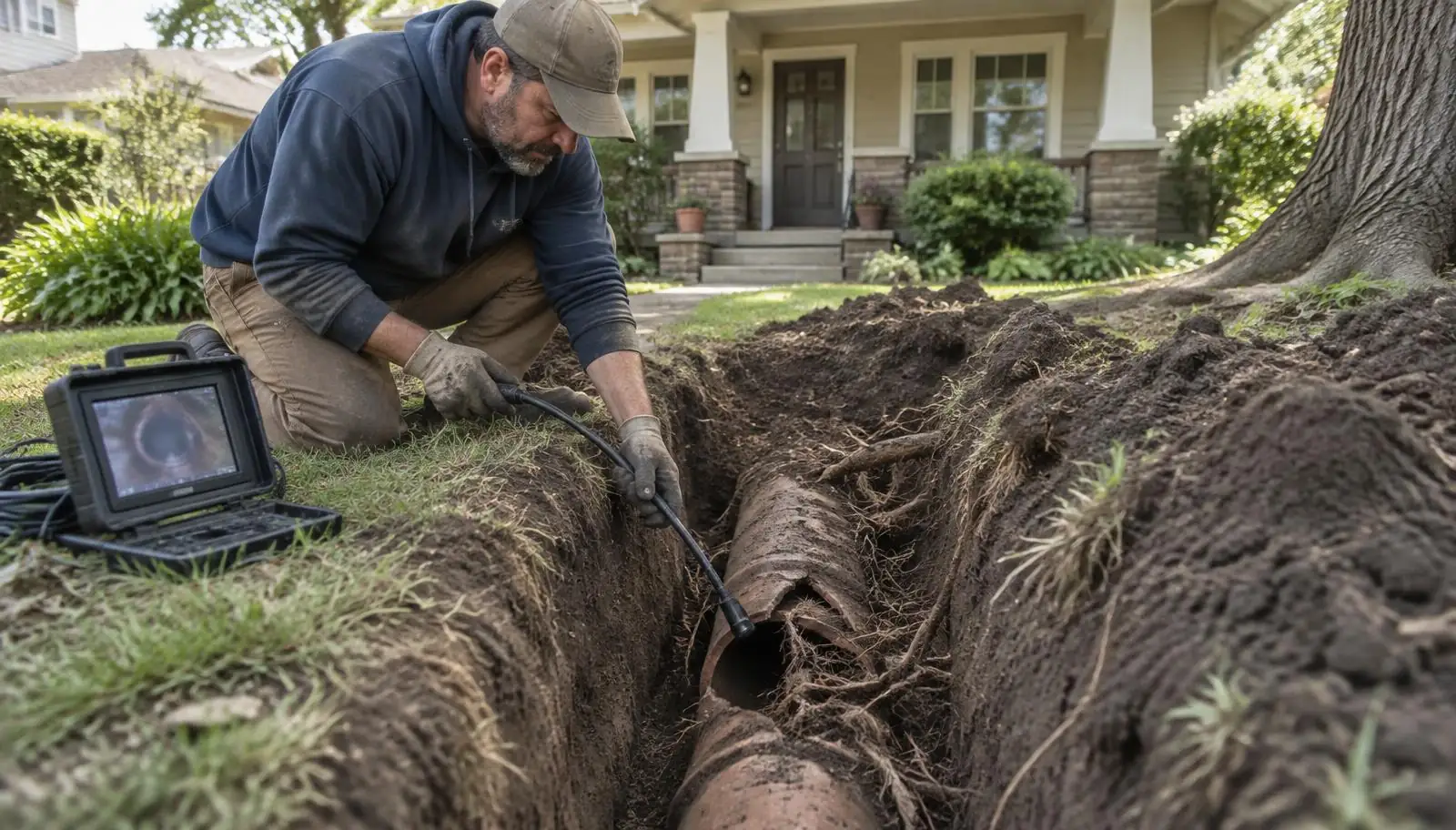
Hire a licensed plumber or sewer contractor to run a camera and give you the recording and a written summary. Ask them to note the pipe material, the location and depth of defects, and any section under the street or a tree. A recording is easier for a buyer to evaluate than a verbal description.
Gather the drain history before talking to buyers
Buyers care about this system's record, not sewer lines in general. Collect what you already have.
Pull invoices for rooter or hydro-jetting service, past camera reports, any spot repair or relining paperwork and permits. Note backup dates, which drains were affected and whether a cleanout was added. If you filed an insurance claim for a backup, keep the claim letter. Our home inspection guide explains how a buyer's inspector may add a sewer scope.
Check whether your city requires a certificate at sale
Some local governments require the lateral to pass a test before title transfers. Find out before you set a closing date.
The East Bay Municipal Utility District's private sewer lateral page lists buying or selling property as a trigger and says a compliance certificate is required to close escrow. Its program covers Alameda, Albany, Emeryville, Oakland, Piedmont, El Cerrito, Kensington and the Richmond Annex. A certificate is issued after the lateral passes a verification test witnessed by an EBMUD inspector.
If the work cannot be finished before transfer, EBMUD offers a time extension certificate that allows 180 days from issue for the work. The buyer and seller negotiate who obtains the certificate. If your home is in that area, see the Oakland sell page and the California page for local context.
Most places have no such rule. Call your city's public works department or sewer utility and ask whether a sale triggers an inspection, and where the owner's responsibility ends.
Who is responsible for the sewer line to the street?
It depends on the local rule. Ask before accepting a quote that includes the street section.
In the East Bay program, owners maintain the entire private lateral, except in Alameda and Albany, where owners are responsible for the upper lateral only. Other cities draw the line at the property line, the curb or the main. That boundary can change a quote considerably.
Price the repair with written quotes
There is no reliable national sewer repair price. Cost depends on length, depth, access, pipe material and whether the street must be opened.
Ask for a written quote that names the method, such as a spot repair, a liner or a full replacement, along with the permit, any street or sidewalk work and yard restoration. Ask whether a passing test or certificate is included where your city requires one. A low quote that excludes concrete or landscape repair is not comparable to a complete one.
If the work cannot be finished before transfer, EBMUD offers a time extension certificate that allows 180 days from issue for the work.
Decision tree: repair, credit or sell as-is
Work through the options to a written net figure for each. Avoid guessing what buyers will think.
Sewer line: camera before quotes
- 1
Inspect
Camera scope of the lateral.
- 2
Local rules
Point-of-sale certificate?
- 3
Price
Written repair or liner quote.
- 4
Compare
Net proceeds per option.
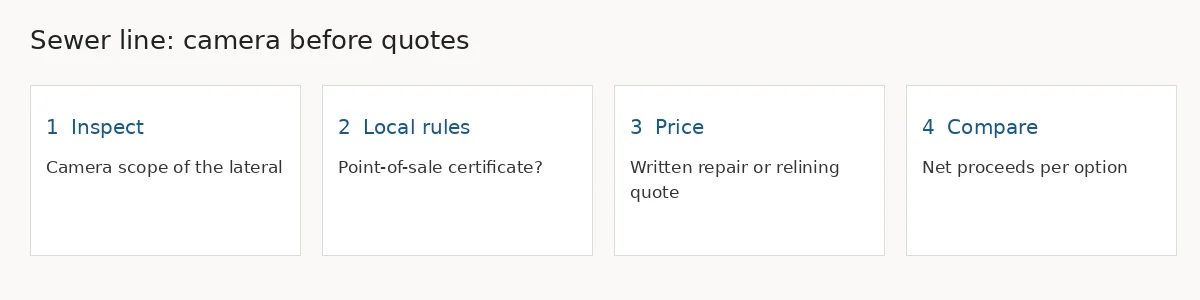
Each path should end in a written net number you can compare.
- Active backup: clear the line and clean up first, whichever path you choose.
- City requires a certificate: follow the local process or its extension option.
- Buyer asks for a repair: compare a closing credit with the quoted work.
- No time or cash for repairs: request a written as-is offer and compare it with the repaired-listing figure.
If the house is on a septic system rather than a public sewer, the failed septic guide covers that situation.
Worked example: repair versus an as-is sale
These figures are labeled examples, not typical prices or SilverCrest results. Replace every number with your own quotes and offers.
Suppose a repaired home could list at $420,000, with $26,000 in expected selling costs and a $14,500 written replacement quote including sidewalk work. The example net is $379,500 before mortgage payoff. An as-is offer of $381,000 with $3,000 in seller costs leaves $378,000 before the same payoff.
In this example the repaired listing is slightly higher, but carrying costs for the repair and listing period can close the gap. The closing-cost calculator helps organize the figures, and sell as-is or fix up first covers the broader trade-off.
Talk to buyers with records, not reassurance
Give buyers the camera recording, the written summary and any quote together. Let them form their own view.
Avoid phrases like "no sewer issues" unless your records support them for your whole ownership. Answer your seller disclosure form accurately and attach records. If a buyer's inspector finds something new, ask for their report and the specific request in writing before negotiating. Money held in escrow for a repair is one option some buyers accept.
When a cash sale may not be your best option
Listing may suit a well-kept home where the sewer problem is a modest spot repair and you have time to finish it. A cracked lateral alone is not a reason to accept a steep discount.
If your written figures show a repaired listing nets more after carrying costs, that is a fair choice. Compare cash offers with listing and ask any buyer to explain how the sewer line affected their number.
Key takeaways
- Start with a camera inspection and keep the recording.
- Collect service invoices, past reports and any claim letters.
- Check whether your city requires a sewer certificate before transfer.
- Confirm where your responsibility for the lateral ends.
- Compare written net proceeds for repair and as-is paths.
The bottom line
Sewer line problems call for a records-first sale, not a guessed discount. Request a cash offer to compare an as-is option, or browse the structural and mold hub. SilverCrest Estates can close in as little as 21 days when title and local requirements allow; choose a later date when you need more time.
Frequently asked questions
Do I have to fix a sewer line before selling?
Usually not, unless your local government requires it. A few programs, such as the East Bay Regional Private Sewer Lateral Program in California, require a compliance certificate or a time extension before title transfers. Check your city or utility first.
Who is responsible for the sewer line to the street?
It depends on the local rule. In the East Bay program, owners are responsible for the entire private lateral, except in Alameda and Albany where responsibility covers the upper lateral only. Ask your city or sewer utility where your responsibility ends.
Can I sell a house with a broken sewer line as-is?
Yes, where no local point-of-sale rule requires a repair first. Disclose what you know, share any camera inspection, and compare a written as-is offer with a repaired listing after the repair quote.
Sources & further reading
Primary sources we consulted for this article. Rules vary by state and change over time — always confirm against the original source.
- 1Private sewer laterals
East Bay Municipal Utility District
Compliance certificate triggers, including buying or selling, and the 180-day time extension.
- 2Private Sewer Lateral Guidelines Booklet
East Bay Regional Private Sewer Lateral Program
Upper and lower lateral definitions, owner responsibility and why older clay laterals fail.
- 3Sanitary Sewer Overflow (SSO) Frequent Questions
U.S. Environmental Protection Agency
Causes of sewer blockages and leaks, including tree roots and defective joints.

About the author
Michael Thompson
Home Selling Expert
Michael Thompson works with the SilverCrest Estates acquisitions team, helping homeowners across 50+ US markets understand their options and close on their own timeline.
Disclaimer: This article is for general information only and is not legal, tax, or financial advice. Real estate rules vary by state and change over time. Consult a licensed attorney, tax professional, or financial advisor about your specific situation before acting.