Start here: this article is part of our distressed sales collection. For the full picture, read our complete guide, Can You Sell a House With Foundation Problems? Your Complete Guide.
Quick answer: Selling a house with a failed septic system may be possible, but disclosure, inspection, repair and financing requirements depend on your location and buyer. SilverCrest Estates can assess an as-is sale. Massachusetts generally requires an inspection within two years before sale; cash payment does not cancel applicable environmental or health requirements.
- Obtain a written inspection identifying the failure, not just a pumping receipt.
- Confirm repair and transfer requirements with the responsible authority.
- Compare repair-and-list, an approved escrow arrangement and an as-is offer.
General education, not legal or engineering advice. State-rule coverage is flagged for attorney review; use a qualified septic professional for diagnosis.
What a failed septic system means for a seller
A failed septic system cannot adequately collect, treat or disperse household wastewater. The problem may involve the tank, piping, pump, distribution components or drainfield, and the repair path depends on the actual diagnosis.
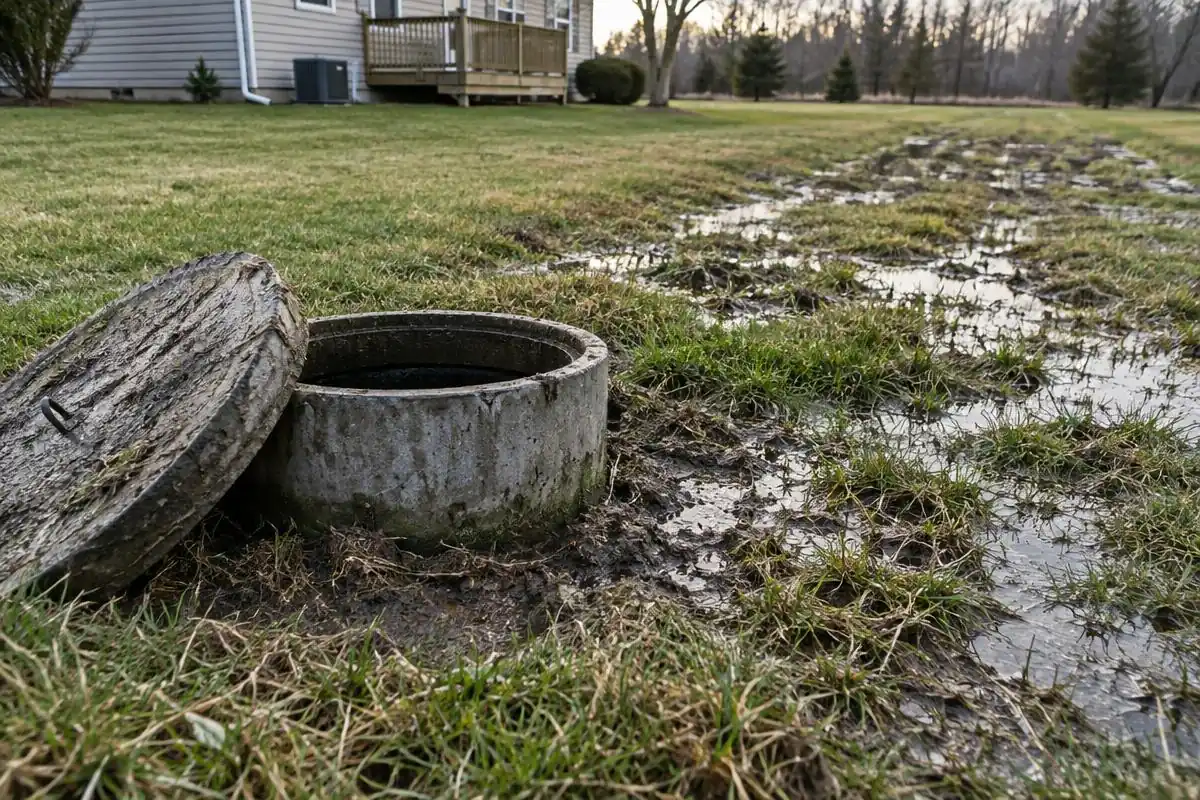
Slow drains alone do not prove that the entire system needs replacement. Conversely, a freshly pumped tank does not establish that the drainfield functions correctly. The EPA's malfunction guidance describes warning signs and explains why failures need professional attention.
If sewage is surfacing or backing up, keep children and pets away, avoid contact and ask the local health authority what immediate precautions are required. Never enter a septic tank or attempt a confined-space inspection. Reduce unnecessary water use while seeking advice, but do not treat that precaution as a permanent repair. Keep photographs and service records for the inspection and your disclosure packet.
Start with a septic inspection before choosing your sale path
A documented inspection separates a limited component repair from a system-wide failure. Ask the inspector to explain the defect, site constraints and what further testing or approval is needed.
Gather the installation permit, system plan, pumping records, prior repair permits and any written notices. Confirm the approved bedroom capacity and whether later additions changed wastewater demand. Tell the inspector if the house has been vacant: low use can conceal symptoms that appear under normal occupancy.
The EPA homebuyer guide provides a practical checklist of records and questions. Use it to organize seller documents, not to diagnose the system yourself. Ask for a written scope that distinguishes required work from optional improvements and identifies whether a private well needs separate testing.
Compare repair-and-list with selling septic problems as-is
The right path depends on the approved repair, available cash, buyer financing and your net proceeds. An as-is purchase agreement can allocate costs, but it cannot erase an enforceable repair or health requirement.
Failed septic sale decision sequence
- 1
Inspect the system
Obtain a written diagnosis.
- 2
Confirm local rules
Ask who approves required work.
- 3
Compare written nets
Include repair and holding costs.
- 4
Agree repair duties
Put deadlines and funding in writing.
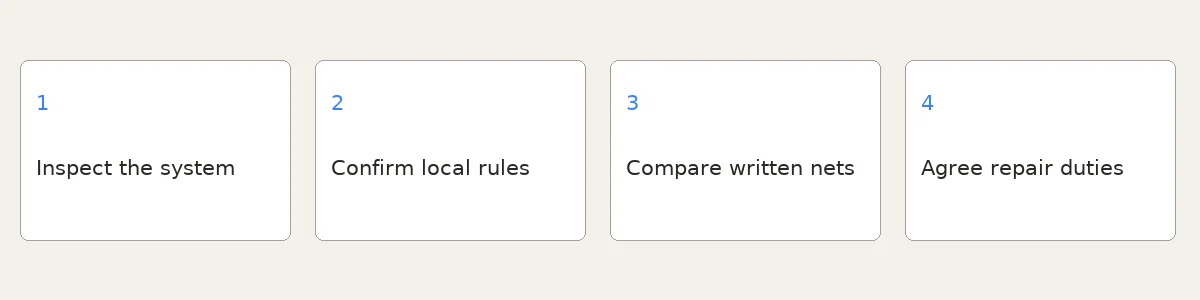
Decision sequence for sellers; an as-is contract does not replace official approval.
Illustrative numbers only: a repaired listing sells for $300,000, with $20,000 in repair costs, $18,000 in selling expenses and $6,000 in additional holding costs. That leaves $256,000 before mortgage payoff and taxes. An as-is offer of $250,000 with $2,000 of seller obligations leaves $248,000 on the same basis. Here listing produces $8,000 more; cash is not automatically the better net.
Obtain multiple written repair quotes where practical. Include design, permits, excavation, restoration and any temporary accommodation required during work. A cheap pumping quote is not comparable with an approved replacement design. Ask whether the buyer's lender accepts the proposed property condition and any repair escrow before treating an offer as workable.
What Massachusetts Title 5 means when selling
Massachusetts has a specific sale-related septic inspection framework under Title 5. MassDEP generally requires inspection within two years before sale, with exceptions and additional rules that must be checked for the particular transfer.
Use MassDEP's buying-or-selling guide and the official 310 CMR 15.000 regulation page. MassDEP explains circumstances in which an inspection can occur after sale because weather prevents access. That is not permission to ignore a known failure or assume any closing can proceed without an inspection.
If the system fails, ask the local approving authority about the required repair, replacement or upgrade and the permitted transaction arrangement. Do not assume the seller must always finish every repair before closing, or that a buyer's promise alone is enough. Put funding, approvals and responsibility into documents reviewed by the closing attorney. See our Massachusetts seller page for sale options, not a substitute for Title 5 advice.
Massachusetts has a specific sale-related septic inspection framework under Title 5.
How Florida differs from Massachusetts
Florida uses its own onsite sewage treatment and disposal permitting framework, not Massachusetts Title 5. Determine the authority responsible for your property's location before scheduling repairs or assuming a transfer inspection rule applies.
The Florida Department of Health onsite-sewage guidance explains the program and permit requirements. Responsibility can involve environmental agencies and county health departments depending on location. A voluntary real-estate inspection is not the same as a permit to repair or modify a system.
Ask who holds your property's records, who approves a repair and whether any outstanding notice affects transfer or occupancy. Give the buyer the same documented information. Our Florida seller page provides the sale connection; verify environmental requirements with the responsible agency rather than a sales representative.
What to disclose about septic failure and repairs
Disclose known septic problems accurately and provide the supporting records required for your transaction. Describing the property as “as-is” does not make a known defect disappear.
Include the failed inspection, recurring backups, surfacing wastewater, repair history, known capacity issues and notices you received. Separate an inspector's conclusions from your own observations. If you do not know the system's age or location, say so rather than guessing. Have your local attorney or agent confirm the applicable disclosure form and any exemptions; this article does not claim one disclosure rule for every state.
Keep copies of what you gave the buyer and any updated report. If a new problem appears before closing, ask how to update the disclosure. Our seller-disclosure guide covers organizing the broader packet, and the major-repairs guide explains comparing condition-related offers.
Write repair responsibilities into the contract
Your agreement should identify who obtains approvals, pays for work and provides completion evidence. A verbal promise to “handle the septic later” leaves important questions unanswered.
If an escrow is proposed, confirm that the lender, closing professional and approving authority accept it. Specify the amount, release conditions, completion deadline and what happens if work exceeds the estimate. Do not use a generic repair allowance without an approved scope. Ask who pays for landscape restoration and any continuing inspection or service agreement.
SilverCrest Estates can review a sale in its current condition and provide written terms. Close in as little as 21 days is possible only when title and applicable transaction requirements allow it; required environmental work or approvals can extend the schedule. Start with a cash-offer request, but do not delay health-authority advice while awaiting an offer.
When a cash sale may not be your best option
Repairing and listing may produce more equity when the failure is limited, the approved repair is affordable and you have time. A move-in-ready home after a straightforward repair can attract a wider buyer pool.
Compare written net estimates rather than accepting a large discount solely because the word “failed” sounds alarming. Our as-is versus fix-up comparison and cash offer versus listing guide help organize that choice. Use the property-condition hub for related condition-sale planning; it does not replace septic engineering advice.
Key takeaways
- Diagnose the actual failure before pricing a replacement.
- Pumping is maintenance, not proof that the system passes inspection.
- Verify state and local requirements and the buyer's financing.
- Compare written repair scopes and complete net proceeds.
- Disclose known problems and document repair responsibilities.
Older rural homes can have more than one hidden condition
A home old enough for an original septic system may also have asbestos pipe wrap or termite-damaged crawlspace framing. Compare selling a house with asbestos and selling a house with termite damage before pricing repairs.
Frequently asked questions
Can I sell my house with a failed septic system?
A sale may be possible if required inspections, disclosures and environmental requirements are addressed. The contract must allocate repair obligations and be acceptable to the buyer, lender and approving authority.
Does a cash buyer remove septic repair requirements?
No. Paying cash removes the mortgage underwriting step, not applicable health, environmental, permit or disclosure requirements. Confirm the approved sale and repair arrangement locally before agreeing to close.
Does pumping mean the septic system passed?
No. Pumping removes accumulated material from the tank; it does not prove the drainfield, piping and other components work. Obtain a documented inspection and diagnosis from a qualified professional.
Sources & further reading
Primary sources we consulted for this article. Rules vary by state and change over time — always confirm against the original source.
- 1Resolving septic system malfunctions
U.S. Environmental Protection Agency
Failure signs and professional diagnosis.
- 2
- 3Buying or selling with a septic system
Massachusetts Department of Environmental Protection
Title 5 inspection requirements and exceptions.
- 4310 CMR 15.000: Title 5
Massachusetts Department of Environmental Protection
Verified official regulation; no guessed subsection.
- 5

About the author
David Park
Seller Success Manager
David Park works with the SilverCrest Estates acquisitions team, helping homeowners across 50+ US markets understand their options and close on their own timeline.
Disclaimer: This article is for general information only and is not legal, tax, or financial advice. Real estate rules vary by state and change over time. Consult a licensed attorney, tax professional, or financial advisor about your specific situation before acting.