Start here: this article is part of our seller questions collection. For the full picture, read our complete guide, Can You Sell a House With a Mortgage? Everything You Need to Know.
Quick answer: You can sell a house with vermiculite insulation, but treat it as if it may contain asbestos and do not disturb it. SilverCrest Estates suggests having a trained professional test it, getting abatement bids if it tests positive, and then deciding whether to remove it, offer a credit or sell as-is with the results disclosed to buyers.
| Step | Why it matters |
|---|---|
| Do not disturb it | Fibers release when moved |
| Test with an accredited pro | Results drive the price |
| Get abatement bids | Removal costs vary widely |
| Disclose the findings | Buyers will ask in inspection |
What vermiculite insulation is
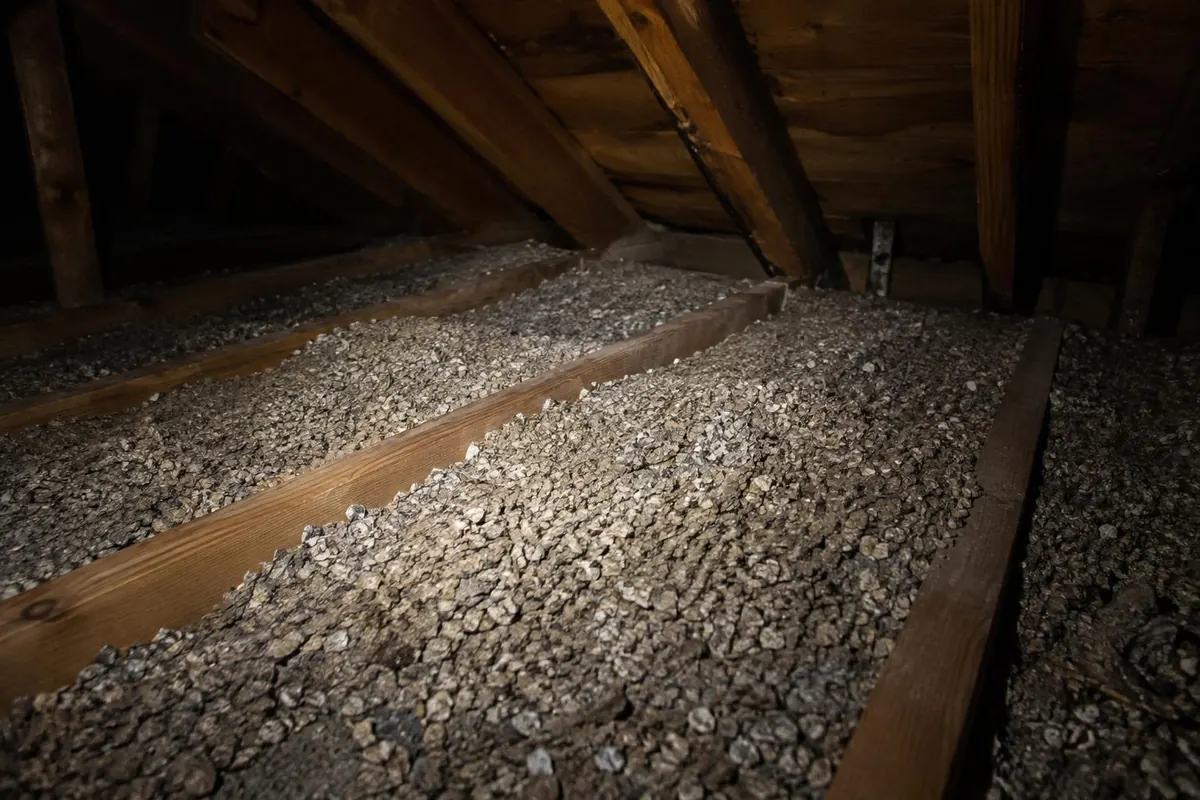
Vermiculite is a mineral that expands into light, pebble-like granules when heated. It was poured loose between attic joists and inside walls for decades.
It usually looks gray-brown or gold, with a shiny, layered texture. It is most often found in attics of homes built before the 1990s. If you see loose granules rather than batts or blown fibers, it may be vermiculite.
Why vermiculite raises asbestos concerns
Much of the vermiculite sold in the United States came from one contaminated mine. That history is why inspectors flag it.
The EPA's Libby asbestos Superfund page explains that vermiculite was mined near Libby, Montana, beginning in the 1920s by the Zonolite Company and later by W.R. Grace, and that the deposit was contaminated with asbestos. Vermiculite from that mine was sold widely, including as Zonolite attic insulation. The EPA's overview of asbestos health effects explains why inhaled fibers are dangerous.
Not every bag of vermiculite came from Libby, and not every attic tests positive. You cannot tell by looking.
Step 1: leave it alone
The safest first step is to do nothing to the insulation. Disturbing it is what releases fibers.
The EPA's asbestos guidance for families says that if in doubt, treat the material as if it contains asbestos and leave it alone. In practice, that means:
- Do not store boxes in the attic or walk across loose insulation.
- Do not sweep, vacuum or remove it yourself.
- Avoid cutting into walls or ceilings below it.
- Keep the attic hatch closed and sealed if possible.
Tell any contractor working near the attic, including roofers and electricians, before they start.
Step 2: have it tested
Testing gives buyers and you a fact instead of a guess. Use an accredited asbestos professional.
The EPA page recommends trained and accredited asbestos professionals for inspection. They take samples carefully and send them to a lab. Because asbestos can be unevenly distributed in vermiculite, some labs and inspectors treat a negative result with caution. Ask the inspector what the result does and does not mean, and keep the written report.
Step 3: price abatement
If the vermiculite tests positive or you choose to treat it as positive, get bids from licensed abatement contractors. Prices vary a lot.
Costs depend on attic size, access, containment needs and local disposal rules. Ask each bidder whether the price includes air monitoring, disposal, new insulation and a clearance report. Some states require licensed contractors and notifications for abatement work.
Check for reimbursement
A trust was created in the W.R. Grace bankruptcy to address Zonolite attic insulation claims. If your attic has Zonolite, check whether a claim program is open and whether it may reimburse part of removal costs before you pay.
It is most often found in attics of homes built before the 1990s.
Worked example: a 1960s ranch
These numbers are an example only, not a SilverCrest Estates case. A 1,400-square-foot ranch has vermiculite across the attic. Testing finds trace asbestos. Two abatement bids come in at $9,500 and $12,000, plus $2,500 for new blown insulation.
Selling a house with vermiculite insulation: steps
- 1
Leave it alone
Do not disturb it.
- 2
Have it tested
Accredited professional.
- 3
Price abatement
Licensed contractor bids.
- 4
Disclose and sell
Repair, credit or as-is.
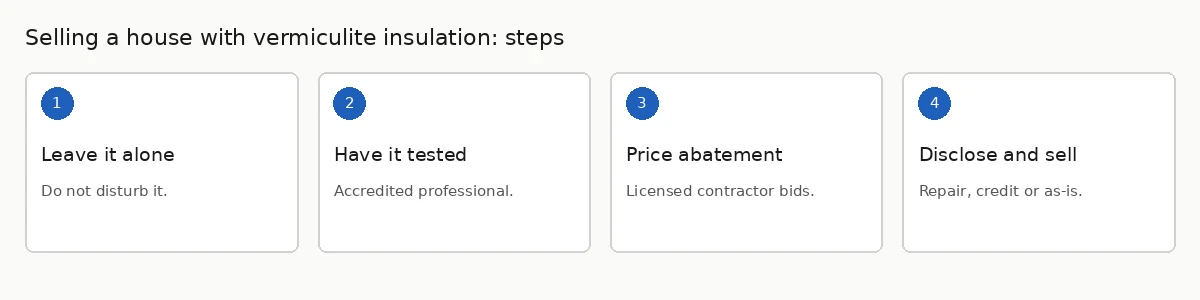
Leave it alone, test, then decide.
If the seller removes it for $12,000 total and lists at $265,000, the house shows without the attic issue. If the seller discloses and offers a $12,000 credit, some buyers will accept; others, worried about health or resale, will walk or ask for more. An as-is buyer may price the issue in and close without a contractor schedule.
How vermiculite differs from other asbestos
Vermiculite is often loose and spread over a large area. That makes it different from asbestos floor tiles or pipe wrap.
Our general asbestos sale guide covers tiles, siding and pipe insulation, which can sometimes be encapsulated in place. Loose attic vermiculite is harder to contain because air moves through attics. If the attic also has moisture or mold, see our mold sale guide.
Disclose what you know
Known vermiculite, test results and abatement work belong in your disclosure. Many forms ask about asbestos directly.
Share the inspector's report and any clearance certificate. Our seller disclosure guide covers state forms. A clear file reassures buyers and their inspectors.
Buyer and lender reactions
Some buyers are comfortable with tested, undisturbed vermiculite; others are not. Expect questions.
Buyers planning attic work, like adding a bathroom fan or rewiring, often push for removal or a credit. Lenders rarely require abatement for undisturbed insulation, but appraisers and inspectors may note it.
Questions buyers usually ask
Expect the same handful of questions at showings and after inspection. Prepared answers keep the deal moving.
- Has it been tested? Share the lab report and the inspector's name.
- Has anyone disturbed it? Note any attic work, such as wiring or roof repairs, and when it happened.
- Is it in the walls too? Some homes have vermiculite poured into wall cavities; say what you know.
- Has any been removed? Provide the abatement contract, disposal records and clearance testing.
If you do not know an answer, say so rather than guess. Buyers can then decide whether to order their own testing before the inspection period ends.
When a cash sale may not be your best option
Vermiculite does not by itself call for a cash sale. If testing is clean or removal is affordable and the house is otherwise in good shape, listing may net more.
A cash sale helps when the house also needs other major work, you cannot manage an abatement project, or buyers keep backing out after inspection. Compare a cash offer with listing with the abatement bid included.
Key takeaways
- Vermiculite may contain asbestos; you cannot tell by looking.
- Leave it alone and keep people out of the attic.
- Test with an accredited professional and keep the report.
- Price abatement and check whether a reimbursement claim applies.
- Disclose the findings to buyers.
The bottom line
Do not disturb it, get facts from a professional, and then choose removal, credit or an as-is sale. Visit the structural issues hub for related guides, or request a written cash offer; SilverCrest Estates can close in as little as 21 days.
Frequently asked questions
Can you sell a house with vermiculite insulation?
Yes. Many older homes have it. You can have it tested, remove it with a qualified contractor, offer a credit or sell as-is, and you should disclose what you know about it.
Does all vermiculite insulation contain asbestos?
Not all, but much of the vermiculite sold in the United States came from a mine near Libby, Montana, that was contaminated with asbestos. EPA advises treating suspect material as if it contains asbestos and leaving it alone.
Should I remove vermiculite before selling?
Not necessarily. Removal is costly and must be done by trained professionals. Some sellers remove it; others disclose it and price the house accordingly.
Sources & further reading
Primary sources we consulted for this article. Rules vary by state and change over time — always confirm against the original source.
- 1Libby Asbestos Superfund Site
U.S. Environmental Protection Agency
History of the Libby vermiculite mine.
- 2Protect your family from exposures to asbestos
U.S. Environmental Protection Agency
Leave suspect material alone; use accredited professionals.
- 3

About the author
Michael Thompson
Property Specialist
Michael Thompson works with the SilverCrest Estates acquisitions team, helping homeowners across 50+ US markets understand their options and close on their own timeline.
Disclaimer: This article is for general information only and is not legal, tax, or financial advice. Real estate rules vary by state and change over time. Consult a licensed attorney, tax professional, or financial advisor about your specific situation before acting.