Start here: this article is part of our seller questions collection. For the full picture, read our complete guide, Can You Sell a House With a Mortgage? Everything You Need to Know.
Quick answer: You can sell a house without homeowners insurance, but you carry every loss until closing, and a mortgage servicer may buy costly force-placed coverage. SilverCrest Estates suggests confirming whether your policy lapsed or was canceled, reading any servicer notices, buying standard or vacant-home coverage for the sale period, and choosing a closing date that keeps uninsured days to a minimum.
| Situation | Practical step |
|---|---|
| Policy lapsed for nonpayment | Ask about reinstatement |
| Insurer canceled or nonrenewed | Shop the state's residual market |
| Servicer sent a force-placed notice | Provide proof of coverage |
| House is vacant | Ask for a vacancy policy |
Why insurance matters during a sale
The seller usually owns the risk until closing. An uninsured fire or storm can wipe out your equity.
Hazard insurance covers physical damage from perils like fire and wind. Many purchase contracts let the buyer cancel or renegotiate if the house is damaged before closing. Without coverage, you would pay for repairs or accept a much lower price.
If you have a mortgage: force-placed insurance
Mortgages almost always require insurance. If coverage lapses, the servicer can buy a policy and bill you.
Federal Regulation X, 12 CFR 1024.37, sets the rules. A servicer must send a written notice at least 45 days before charging you for force-placed insurance, followed by a reminder notice. If you send proof of coverage, the servicer must cancel the force-placed policy and refund premiums for overlapping periods. Force-placed policies usually cost more and often protect only the lender's interest, not your belongings or liability.
If you are also behind on payments, see our guide to selling a house behind on mortgage payments.
Why policies lapse or get canceled
Knowing the reason helps you fix it. Each cause has a different path.
- Missed premium payments. Some insurers will reinstate within a grace period.
- Escrow shortage. If insurance was paid from escrow and the escrow ran short, call the servicer.
- Nonrenewal for risk. Insurers in high-risk areas sometimes decline to renew roofs, older wiring or coastal homes.
- Vacancy. Many policies limit coverage after the house has been empty for a period stated in the policy.
Step 1: check your status today
Find out exactly where you stand. Call your insurer and your servicer the same day.
Ask the insurer whether the policy is active, lapsed or canceled, and the effective date. Ask the servicer whether force-placed coverage is in effect and what it costs. Request copies of every notice.
Step 2: get coverage for the sale period
Short-term coverage is usually available, though it may cost more. Shop quickly.
Standard reinstatement
If the lapse was for nonpayment, ask whether paying now reinstates the policy without a gap. Get confirmation in writing.
State residual market plans
Many states run a plan for homeowners who cannot find coverage in the regular market, often called a FAIR plan or a citizens plan. Coverage is more limited, but it can bridge the sale period.
Vacant dwelling policies
If you moved out, ask for a vacancy endorsement or a separate vacant dwelling policy. Our guide to selling a vacant house covers security and utilities.
Flood
Standard policies generally exclude flood. FloodSmart explains that flood insurance is a separate policy, usually with a waiting period before it takes effect.
A servicer must send a written notice at least 45 days before charging you for force-placed insurance, followed by a reminder notice.
Step 3: shorten the uninsured window
The fewer days without coverage, the lower your risk. A firm closing date helps.
Buyers using mortgages need time for appraisal and underwriting, and their lender will require the buyer's own insurance, which can be hard to bind on a house an insurer will not cover. A cash buyer is not bound by a lender's insurance requirement, which can shorten the timeline.
Worked example: a lapsed policy on a vacant house
These numbers are an example only, not a SilverCrest Estates case. An owner moved out of an inherited house eight months ago. The policy lapsed during the move, and the servicer sent a force-placed notice quoting $4,800 a year.
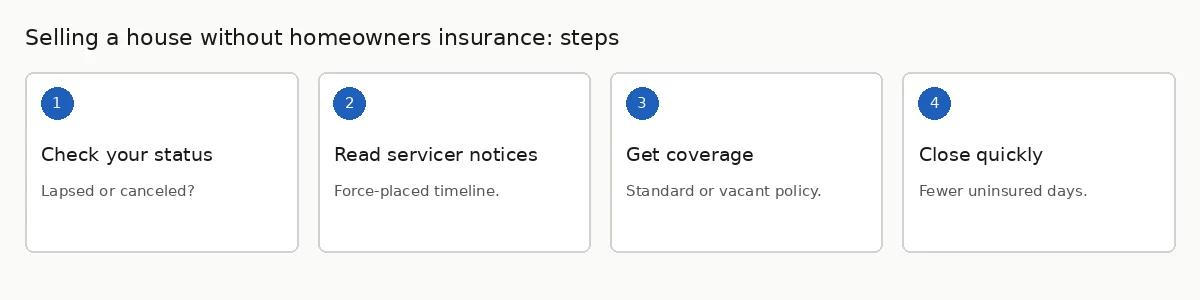
Selling a house without homeowners insurance: steps
- 1
Check your status
Lapsed or canceled?
- 2
Read servicer notices
Force-placed timeline.
- 3
Get coverage
Standard or vacant policy.
- 4
Close quickly
Fewer uninsured days.
Cover the gap, then close.
The owner buys a six-month vacant dwelling policy for $1,300, sends proof to the servicer, and gets the force-placed charge canceled. With coverage in place, the owner compares a listed sale that may take three months with a cash offer closing in about three weeks, and chooses based on net and risk.
Disclose the reason if it matters
An insurance problem can signal a condition buyers will ask about. Be ready with facts.
If an insurer nonrenewed because of the roof, wiring or a past claim, buyers may face the same problem. Our guides to selling with a bad roof and hurricane damage cover common causes. Disclose known defects as your state requires.
Questions to ask an insurance agent
An independent agent can shop several insurers at once. Bring the house's details and ask directly.
- Will you write a policy on a house that is listed for sale or vacant?
- What would disqualify the house, such as roof age, wiring or past claims?
- Is there a short-term or monthly policy for the expected sale period?
- How quickly can coverage start, and is there a waiting period?
- Will the policy cover liability if a buyer or contractor is injured during a showing?
Write down each quote and its exclusions. The cheapest policy is not always the right one if it excludes the very risk you are worried about, such as wind on the coast or vandalism in a vacant house.
Keep the declarations page, the effective dates and the agent's contact details in your closing file. The title company and buyer may ask for proof that the house was insured through the closing date, and having it ready avoids a last-minute scramble.
When a cash sale may not be your best option
A lapsed policy alone does not mean you must sell for cash. If you can restore coverage and the house is insurable, a financed buyer may pay more.
A cash sale helps when insurers refuse the house, a buyer's lender cannot get coverage bound, or the house is vacant and at risk. Compare a cash offer with listing including insurance and carrying costs.
Key takeaways
- Sellers usually carry the risk until closing.
- Servicers must give notice at least 45 days before charging for force-placed coverage.
- Proof of your own coverage cancels force-placed insurance.
- Vacant homes often need a vacancy policy.
- Shorten the uninsured window with a firm closing date.
The bottom line
Restore coverage first, then pick the fastest sensible path to closing. Visit the behind on payments hub for related guides, or request a written cash offer; SilverCrest Estates can close in as little as 21 days.
Frequently asked questions
Can you sell a house without homeowners insurance?
Yes. No law requires a seller to carry insurance to sell, but a mortgage usually requires it, and an uninsured loss before closing would fall on you. Most sellers arrange coverage until closing.
What is force-placed insurance?
If you have a mortgage and let coverage lapse, the servicer can buy insurance and charge you. Federal Regulation X requires written notices, including one at least 45 days before charging you.
Do I need vacant home insurance if I moved out?
Often yes. Many standard policies limit coverage after a home has been vacant for a set period, so ask your insurer about a vacancy endorsement or a vacant dwelling policy.
Sources & further reading
Primary sources we consulted for this article. Rules vary by state and change over time — always confirm against the original source.
- 1
- 2
- 3

About the author
Jennifer Martinez
Real Estate Consultant
Jennifer Martinez works with the SilverCrest Estates acquisitions team, helping homeowners across 50+ US markets understand their options and close on their own timeline.
Disclaimer: This article is for general information only and is not legal, tax, or financial advice. Real estate rules vary by state and change over time. Consult a licensed attorney, tax professional, or financial advisor about your specific situation before acting.