Quick answer: It is usually not too late to stop foreclosure until the sale itself happens, and in a few states you can still redeem afterward. Federal rules bar most servicers from starting foreclosure until you are more than 120 days behind. SilverCrest Estates sees four exits that stay open late: reinstate, apply for help, sell before the sale date, or file bankruptcy.
| Stage | What can still stop it |
|---|---|
| Under 120 days late | Repayment plan, forbearance, loan modification |
| Foreclosure started | Reinstatement, complete loss mitigation application, sale |
| Under 37 days to sale | Reinstatement, payoff from a closed sale, bankruptcy |
| After the sale | Redemption only where state law allows it |
General education, not legal advice.
When is it too late to stop foreclosure?
For most homeowners, the hard deadline is the foreclosure sale itself. Before that moment, paying what is owed, closing a sale that pays the loan off, or a court order can still stop it.
What changes as the date gets closer is how many options remain. In the last few weeks, only options that produce money or a legal stop on a fixed schedule still work.
When is it too late to stop foreclosure?
- 1
Missed payments
Most options still open.
- 2
120 days late
Foreclosure can start.
- 3
37 days out
Late help gets harder.
- 4
Sale day
Usually the last chance.
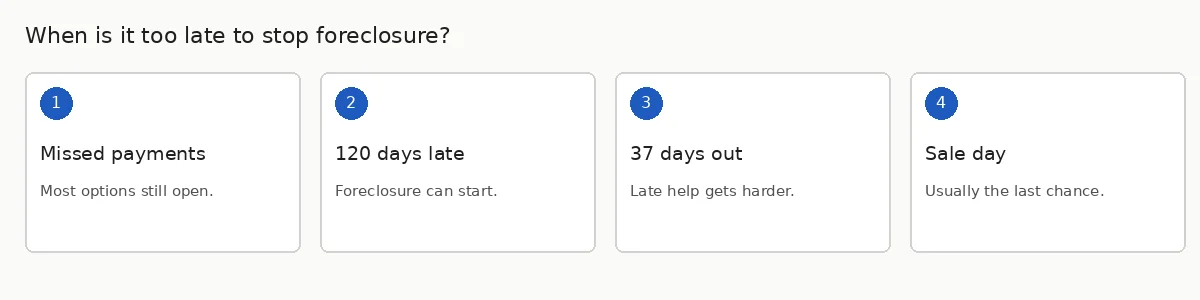
Options narrow as the sale date gets closer.
The 120-day rule: when foreclosure can start
Under the federal mortgage servicing rule in Regulation X, a servicer generally cannot make the first notice or filing for foreclosure until the borrower is more than 120 days delinquent. That window is meant for loss mitigation.
The rule, at 12 CFR 1024.41(f), covers most first-lien mortgages on a primary home; some small servicers are exempt from parts of it. If you are inside this window, the behind on payments hub explains repayment plans and forbearance.
Is it too late once foreclosure has started?
No. Once the first notice is recorded or the lawsuit is filed, you can still reinstate the loan, submit a full loss mitigation application, or sell the house and pay off the loan at closing.
A notice of default or a foreclosure complaint is the beginning of a process, not the end. In California, for example, Civil Code section 2924 requires at least three months between recording the notice of default and giving notice of sale. Our guide to what to do after a notice of default walks through the first two weeks.
Can you still get a loan modification?
Often, yes, but timing matters. Regulation X gives the strongest protection to a complete application received more than 37 days before a scheduled sale: the servicer must evaluate it, and if the application arrived after the first filing, the servicer cannot move for judgment or conduct the sale until it has decided.
An incomplete application does not trigger that protection, so send every document requested and keep proof of delivery.
Is it too late with a sale date scheduled?
Not necessarily. Inside the final weeks, the realistic exits are reinstatement, paying the loan off through a sale that closes before the auction, or a bankruptcy filing.
Reinstating the loan
Reinstatement means paying every missed payment plus fees and costs to bring the loan current. In California, Civil Code section 2924c lets the borrower reinstate up to five business days before the sale date. Other states set different cutoffs, and some loan documents add their own. Ask for a written reinstatement quote good through a specific date.
Selling before the sale date
A sale that closes before the auction pays the loan off and stops the foreclosure. It only works if title is clear, the buyer can close on time and the price covers the payoff, or the lender approves a short sale. Ask the servicer for a written payoff statement and send them the signed contract so they know a closing is scheduled.
Filing bankruptcy
A bankruptcy petition triggers the automatic stay under 11 U.S.C. 362, which generally stops a foreclosure sale while the case is open. It has its own costs and credit effects, and repeat filings can limit the stay.
362, which generally stops a foreclosure sale while the case is open.
State timelines: how long you have
Foreclosure timelines vary widely, so "too late" depends on where the house is. Nonjudicial states can move from first notice to sale in a few months; judicial states usually take longer because a court must rule.
In Texas, Property Code section 51.002 generally requires at least 20 days to cure a default on a primary residence before notice of sale, then at least 21 days' notice before a sale held on the first Tuesday of a month. That can mean only weeks once the notices start. Our Texas foreclosure timeline covers the full sequence.
| Example | Key statutory step |
|---|---|
| California | 3 months after the notice of default before notice of sale |
| Texas | 20-day cure notice, then 21-day sale notice |
| Minnesota | Redemption period after sale, generally six months |
Is it too late after the foreclosure sale?
Usually, yes, but not everywhere. A handful of states give owners a right to redeem after the sale by paying the sale price plus allowed costs within a set period.
In Minnesota, Statutes section 580.23 generally gives the mortgagor six months after the sale to redeem, with longer periods in some cases. Many other states end the owner's rights at the sale. See the redemption period for the basic idea.
Worked example: what selling late can save
Illustrative numbers only. A homeowner owes $182,000 and is 7 months behind with $14,500 in arrears, fees and costs. The house is worth about $260,000 as-is. With a sale date 30 days away and no money to reinstate, she signs a sale at $248,000. After the $196,500 payoff and $6,000 in other costs, she keeps about $45,500.
If the auction goes ahead instead, any surplus depends on the bid, and many sales end with the lender buying at or below the debt.
How to check how much time you have
Call the servicer and the trustee or court today and get three things in writing: the sale date, the reinstatement amount and the payoff amount. Then read your mail for the recorded notices.
- Find the sale date on the notice of sale, the court docket or the trustee's website.
- Ask the servicer whether a postponement is possible if a sale is under contract.
- Contact a HUD-approved housing counselor; the HUD counselor search lists agencies near you.
- Watch for anyone who asks for an upfront fee to "save" the house; the FTC warns that charging before you accept a lender's offer is illegal.
When a cash sale may not be your best option
A cash sale is not the right choice if you can afford to reinstate, qualify for a modification you can keep paying, or have months before any sale and a house ready to list. Keeping the home or listing it usually leaves more money in your pocket.
Compare written numbers with our cash offer vs listing guide and the general options for avoiding foreclosure. A fast sale fits best when the sale date is close and the house needs repairs a listing buyer would not accept.
Key takeaways
- It is usually too late only after the foreclosure sale.
- Most servicers cannot start foreclosure until you are more than 120 days behind.
- A complete application more than 37 days before the sale gets the most protection.
- Reinstatement, a sale that closes first, or bankruptcy can still stop a scheduled sale.
- A few states allow redemption after the sale.
The bottom line
Get the sale date, reinstatement figure and payoff figure in writing, then pick the exit that fits the time left. If selling is the right call, request a written cash offer. SilverCrest Estates can close in as little as 21 days when title and the lender payoff allow it.
Frequently asked questions
When is it too late to stop foreclosure?
For most homeowners, once the foreclosure sale has been completed. Before then, reinstating, paying the loan off through a sale that closes first, or a bankruptcy filing can usually still stop it. A few states also allow redemption after the sale.
Can I stop a foreclosure sale the day before?
Sometimes. A bankruptcy filing triggers an automatic stay, and some states allow reinstatement until shortly before the sale, such as five business days in California. A sale that has already closed and paid off the loan also stops it.
How many missed payments before foreclosure starts?
Under federal Regulation X, most servicers cannot make the first foreclosure notice or filing until you are more than 120 days delinquent, which is roughly four missed monthly payments.
Sources & further reading
Primary sources we consulted for this article. Rules vary by state and change over time — always confirm against the original source.
- 112 CFR 1024.41 Loss mitigation procedures
Cornell Legal Information Institute
120-day first-notice rule and the 37-day complete-application protection.
- 2Civil Code section 2924c
California Legislative Information
Reinstatement up to five business days before the sale.
- 3Right of redemption
Cornell Legal Information Institute
How statutory redemption after a foreclosure sale works.
- 411 U.S.C. 362 Automatic stay
Cornell Legal Information Institute
Stay of acts against property after a bankruptcy petition.

About the author
Lisa Anderson
Homeowner Advocate
Lisa Anderson works with the SilverCrest Estates acquisitions team, helping homeowners across 50+ US markets understand their options and close on their own timeline.
Disclaimer: This article is for general information only and is not legal, tax, or financial advice. Real estate rules vary by state and change over time. Consult a licensed attorney, tax professional, or financial advisor about your specific situation before acting.