Quick answer: A notice of default means your lender has formally started the foreclosure process, but you usually still have months, not days. Read the notice, confirm the amount and the cure deadline, call the servicer, and contact a HUD-approved housing counselor. SilverCrest Estates sees most owners resolve it by reinstating, getting a workout, or selling before a sale date.
| First 14 days | Why it matters |
|---|---|
| Read the notice and note every date | Sets your real deadline |
| Request reinstatement and payoff figures | Shows what each exit costs |
| Submit a complete help application | Triggers federal review rules |
| Decide: keep, rework or sell | Leaves time to act |
General education, not legal advice.
What does a notice of default mean?
A notice of default is the lender's formal statement that the loan is in default and that it intends to foreclose if the default is not fixed. It is not a sale date and it does not mean you have lost the house.
In states that foreclose without a court, the notice is often recorded with the county. In California, Civil Code section 2924 requires the notice of default to be recorded and at least three months to pass before notice of sale can be given. Texas uses a written notice of default and opportunity to cure. Judicial states start with a lawsuit instead. Our glossary entry gives the short definition.
Is a notice of default a foreclosure?
It is the first formal step of one. Foreclosure becomes final only at the sale, so the time between the notice and the sale is when you can still act. Under Regulation X, most servicers cannot make this first notice or filing until you are more than 120 days delinquent, so you have usually already received calls and letters.
Step 1: read the notice line by line
Start with the document itself. Every exit depends on the amount and the dates printed on it.
Look for the amount needed to cure, the date the default began, the name of the trustee or attorney, the property description and any recording date or number. If the amount looks wrong, write to the servicer and ask for an itemized breakdown; Regulation X lets borrowers send a written notice of error and request information about their account.
Received a notice of default: what to do
- 1
Read it
Amount, dates, trustee.
- 2
Get figures
Reinstatement and payoff.
- 3
Apply for help
Complete application.
- 4
Choose a path
Keep, rework or sell.
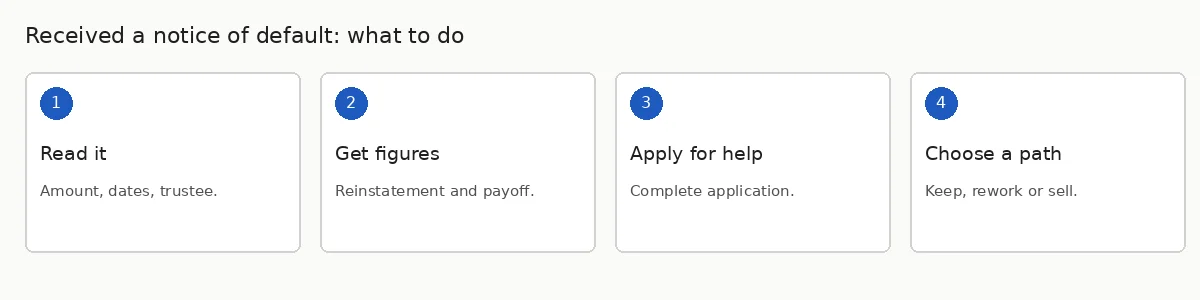
Work through these in the first two weeks.
Step 2: get the reinstatement and payoff figures
Ask the servicer for two written numbers: the reinstatement amount to bring the loan current, and the full payoff amount to close the loan. They answer different questions.
Reinstatement keeps the home on the current loan; payoff is what a sale must cover. Ask for each figure good through a specific date. In California, Civil Code section 2924c lets the borrower reinstate up to five business days before the sale. Federal rules also require a servicer to send an accurate payoff statement within seven business days of a written request, with some exceptions. See reinstatement quote for what the figure includes.
Step 3: apply for loss mitigation
Send a complete loss mitigation application as early as you can. Federal servicing rules give the most protection to complete applications.
Under 12 CFR 1024.41, if a servicer receives a complete application more than 37 days before a foreclosure sale, it must evaluate you for every option it offers and send a written decision. A servicer that already started foreclosure generally cannot move for judgment or conduct the sale while a timely complete application is pending. Options can include a repayment plan, forbearance, a loan modification, a short sale or a deed in lieu.
A HUD-approved housing counselor can help at no charge; the HUD counselor search lists agencies by location.
What if I cannot afford to catch up?
Then the choice is usually between a workout the servicer approves and a sale on your terms. If the house has equity, selling before the sale date usually keeps much more of it than an auction. If you owe more than it is worth, ask about a short sale.
Under Regulation X, most servicers cannot make this first notice or filing until you are more than 120 days delinquent, so you have usually already received calls and letters.
Step 4: decide whether to keep, rework or sell
Pick a path by comparing three numbers: what keeping the home costs each month, what a workout changes, and what a sale would leave you after payoff.
| Path | Fits when |
|---|---|
| Reinstate | You can pay the arrears now and afford future payments |
| Workout | Income dropped for a reason that is improving |
| List with an agent | Months remain and the house is ready to show |
| Sell as-is | Time is short or the house needs work |
Worked example: equity at risk
Illustrative numbers only. A homeowner receives a notice of default showing $11,800 to cure. She owes $164,000 and the home is worth about $235,000. She cannot reinstate, and a modification would still leave a payment she cannot carry.
Selling at $226,000 with $7,000 in costs and a $177,000 payoff, including arrears and fees, leaves about $42,000. Losing at auction could leave her only whatever surplus the bid produced, if any.
What to tell the servicer if you sell
Tell the servicer in writing that the property is under contract and give the closing date. Send a copy of the contract and an authorization so the title company can request the payoff.
If the sale will close close to a scheduled sale, ask whether the trustee or attorney will postpone it with a contract in hand; they are not always required to. Keep every letter, email and call log. Our behind on payments hub and the guide to selling a house behind on mortgage payments cover the closing steps.
How long after a notice of default is the sale?
It depends on the state. In California the law requires at least three months before notice of sale, plus at least 20 days of sale notice. In Texas the cure period on a primary home is at least 20 days, followed by at least 21 days' notice before a first-Tuesday sale under Property Code section 51.002.
Judicial states usually take longer because the court must enter judgment first. Our Texas foreclosure timeline and when is it too late to stop foreclosure guides cover the later stages.
Avoid foreclosure rescue scams
People who read public notices often contact owners soon after a notice of default is recorded. Some are legitimate; some are not.
The FTC's mortgage relief scam guidance warns against anyone who demands an upfront fee, tells you to stop paying your lender or to send payments to them, or asks you to sign over the deed. Never sign a deed or power of attorney you do not fully understand.
When a cash sale may not be your best option
A cash sale is not the best choice when you can reinstate, when a modification would make the loan affordable, or when the house is in good shape and you have time to list. Keeping the home or listing it usually nets more.
Compare written net proceeds in the cash offer vs listing guide. A fast as-is sale fits when time is short, the house needs repairs, or you want a fixed closing date.
Key takeaways
- A notice of default starts foreclosure; it is not the sale.
- Confirm the cure amount and every date on the notice.
- Request both reinstatement and payoff figures in writing.
- A complete loss mitigation application sent early gets the most protection.
- Selling before the sale date can protect equity an auction could take.
The bottom line
A notice of default gives you a deadline, and usually enough time to choose. Get the figures, apply for help, and compare keeping the home with selling it. If selling makes sense, request a no-obligation cash offer; SilverCrest Estates can close in as little as 21 days when title and the lender payoff allow.
Frequently asked questions
Is a notice of default a foreclosure?
It is the first formal step of one, not the sale. Ownership changes only at the foreclosure sale, so the time between the notice and the sale is when you can still reinstate, get a workout or sell.
How long after a notice of default is the sale?
It depends on the state. California requires at least three months after the notice of default before notice of sale. Texas requires at least a 20-day cure period and then at least 21 days' notice before a sale.
Can I sell my house after a notice of default?
Yes. A sale that closes before the foreclosure sale pays off the loan from the proceeds and stops the foreclosure, as long as the price covers the payoff or the lender approves a short sale.
Sources & further reading
Primary sources we consulted for this article. Rules vary by state and change over time — always confirm against the original source.
- 1Civil Code section 2924
California Legislative Information
Recording the notice of default and the three-month wait.
- 212 CFR 1024.41 Loss mitigation procedures
Cornell Legal Information Institute
Evaluation of complete applications received more than 37 days before a sale.
- 3Texas Property Code chapter 51
Texas Constitution and Statutes
20-day cure notice and 21-day sale notice.
- 4

About the author
Jennifer Martinez
Real Estate Transaction Specialist
Jennifer Martinez works with the SilverCrest Estates acquisitions team, helping homeowners across 50+ US markets understand their options and close on their own timeline.
Disclaimer: This article is for general information only and is not legal, tax, or financial advice. Real estate rules vary by state and change over time. Consult a licensed attorney, tax professional, or financial advisor about your specific situation before acting.