Start here: this article is part of our selling your home collection. For the full picture, read our complete guide, How to Sell Your House Fast: The Complete Homeowner's Guide.
Quick answer: Yes, you can sell a house with unpermitted work. Pull the permit history from the building department that covers your address, list each change made without a permit, then price three paths: legalize it with an after-the-fact permit, remove it, or disclose it and sell as-is. Fees and timelines vary locally. SilverCrest Estates can buy with the work disclosed.
- Request the property's permit history before you list or accept an offer.
- Get written quotes for legalizing or removing each item.
- Disclose what you know, then compare written net proceeds for every path.
General education, not legal advice. Disclosure and permit rules vary by state, county and city; this topic is flagged for attorney review.
Can you sell a house with unpermitted work?
Yes. No federal rule stops you from selling a house with unpermitted work. It changes who will buy, how lenders treat the space and what you must disclose.
It usually surfaces in the buyer's inspection, the appraisal or a permit search. Finding it first lets you set the price instead of renegotiating under a deadline.
What counts as unpermitted work?
Unpermitted work is any construction or system change that needed a building permit and final inspection but never got one. Your local building code decides which jobs need permits, so the same project can need one in one city and not the next.
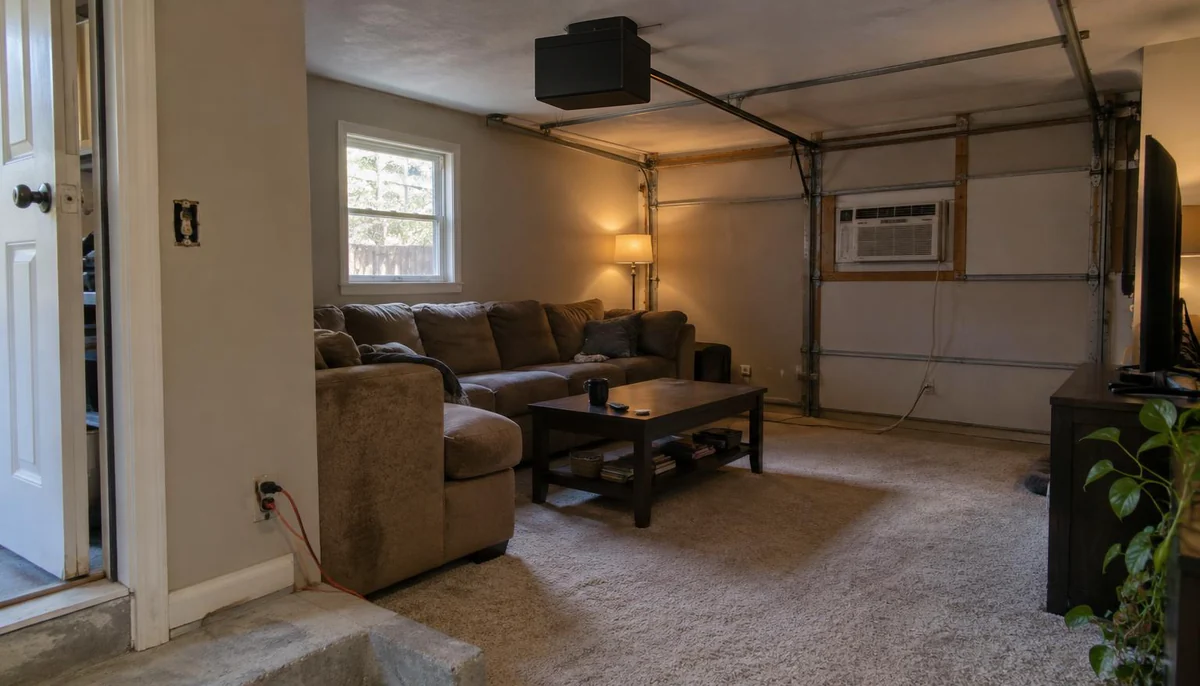
Common examples: garage conversions, finished basements with added bedrooms or baths, decks and room additions, moved walls or enlarged windows, and electrical, plumbing, water heater or HVAC replacements. Open permits from a stalled project are a related problem covered in our unfinished renovation guide; active city citations are covered in selling a house with code violations.
Is older work grandfathered?
Work permitted under the code in effect when it was built generally doesn't have to meet today's code. Never-permitted work doesn't become legal with age, though local offices treat old work differently, so ask yours.
How to find out what was permitted
Start with the permit history for your address, then compare it with what is actually there. Most building departments let owners request records online, by email or at a counter.
- Request the permit history and any final inspections or certificate of occupancy.
- Compare the property tax record's square footage, bedroom and bathroom counts with the house.
- Gather contractor invoices, old listing photos and your purchase inspection report.
- Make a simple list: each change, the year, and whether a permit exists.
Selling a house with unpermitted work: decision sequence
- 1
Find the record
Pull permit history from the building office.
- 2
Scope the gap
List each change and what it needs.
- 3
Price each path
Legalize, remove or disclose as-is.
- 4
Disclose & close
Share records; compare written nets.
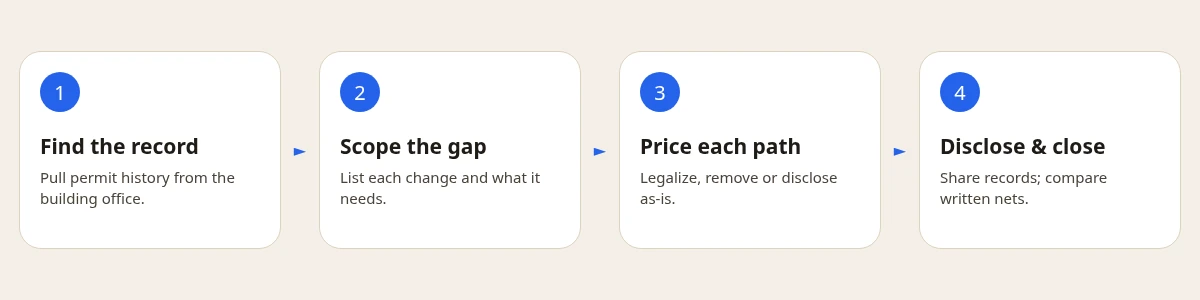
Decision sequence for sellers; one house can have several items on different paths.
Who issues permits for your address
In many metro areas the city issues permits inside its limits, and the county handles only unincorporated areas. For example, the Cook County Department of Building and Zoning issues permits and inspects work in unincorporated Cook County, Illinois, while Chicago runs its own office. The Miami-Dade County Building department handles permits for unincorporated Miami-Dade, while cities such as Miami and Hialeah have their own building departments. Confirm which office covers your exact address first.
Listing as-is with full disclosure at $322,000, if the market values the room less, nets $302,680 after $19,320 in selling costs, with more financing risk.
Your three options: legalize, remove or disclose
Each item on your list gets one of three paths. You can mix them: legalize the deck, remove a homemade wiring run, and disclose an older basement finish.
How to get a permit after work is done
An after-the-fact or retroactive permit usually means applying as if the work were new, sometimes with drawings, then passing inspection. Inspectors may ask you to open drywall, and code corrections must be fixed before final approval. Some jurisdictions charge extra for work started without a permit; get the process and fee schedule in writing.
Remove or restore the work
Returning a space to its permitted use, such as converting a garage bedroom back to a garage, can cost less than legalizing it. Removal that needs a permit should be permitted.
Disclose and sell as-is
Disclose the work, price it fairly and let the buyer decide. This avoids construction delays but narrows the buyer pool, especially among financed buyers.
Worked example: legalize, list as-is or take a cash offer?
Illustrative numbers only. A 280-square-foot garage conversion. If legalized, the home might list at $340,000. Permit and plan fees of $1,500, wall opening and corrections of $6,000, and $3,000 in holding costs during ten weeks, plus 6% selling costs ($20,400), net $309,100 before mortgage payoff.
Listing as-is with full disclosure at $322,000, if the market values the room less, nets $302,680 after $19,320 in selling costs, with more financing risk. An as-is cash offer of $295,000 with $1,500 in costs nets $293,500. Legalizing wins by about $15,600 here, but only if the inspection finds no major hidden corrections and you can carry the house for ten weeks.
The decision rule: legalize when the value the permitted space adds exceeds legalization costs plus holding costs, and your timeline can absorb an inspection surprise.
How unpermitted work affects appraisals and financing
Appraisers must address it. Fannie Mae's Selling Guide on the improvements section of the appraisal says that when an appraiser identifies an addition without the required permit, the appraiser must comment on the quality and appearance of the work and its impact, if any, on market value.
FHA guidance in HUD Handbook 4000.1 sets minimum property requirements, and a lender may condition the loan on repairs or documentation, which can stall a deal late.
Cash buyers don't depend on lender conditions, so they can close with the work documented and price the risk in.
What happens if an inspector finds unpermitted work?
A buyer's home inspector usually reports it as a finding and recommends checking permit records. The buyer may then ask you to legalize it, offer a credit, or reduce the price, and may cancel if the contract's inspection terms allow. A municipal inspector who sees the work during another permit can require it to be corrected. See how home inspections affect a sale for responding to findings.
What to disclose about unpermitted work
Disclose known unpermitted work wherever your state's seller disclosure rules require it. Texas's Seller's Disclosure Notice, published by the Texas Real Estate Commission, asks whether the seller is aware of room additions, structural modifications, or other alterations or repairs made without necessary permits or not in compliance with building codes in effect at the time.
Include what was done, roughly when, by whom, and any records. Never paint over or stage around problems to hide them; an as-is sale limits repairs, not the duty to share known material facts. Our seller disclosure guide explains how to assemble the packet.
What if a seller didn't disclose unpermitted work?
A buyer who later discovers known, undisclosed work may bring a claim based on state disclosure or misrepresentation law. Outcomes depend on the facts and the state, so talk to a real estate attorney before you sign disclosures if you are unsure what counts.
When a cash sale may not be your best option
A cash sale is not always the better choice. If the unpermitted item is small, the building office gives you a clear path and fee, and the rest of the house is move-in ready, legalizing and listing may net more.
Compare selling as-is or fixing up first and use our cash offer vs listing guide to compare written nets.
SilverCrest Estates buys houses with unpermitted work in their current condition, with no permits required first; our unfinished remodels page explains how. Close in as little as 21 days when title and transaction requirements allow. Request a no-obligation cash offer and compare it with your legalize-and-list net.
Key takeaways
- Unpermitted work is sellable; the permit history tells you what you're dealing with.
- Each item can be legalized, removed or disclosed and sold as-is.
- Appraisers must comment on additions without permits, and lenders may add conditions.
- Disclose known unpermitted work and never conceal it.
Frequently asked questions
Can you sell a house with unpermitted work?
Yes. You can legalize it with an after-the-fact permit, remove it, or disclose it and sell as-is. The permit history for your address shows what you're dealing with before you set a price.
What happens if you sell a house with unpermitted work?
If it's disclosed, the buyer prices it in or asks for a credit, and lenders may add conditions. If known work is hidden, the buyer may have a claim after closing under state disclosure law.
How do you get a permit after work is done?
Apply to the building department that covers your address for an after-the-fact permit. Expect possible drawings, wall openings for inspection, code corrections and fees set by the local schedule.
Sources & further reading
Primary sources we consulted for this article. Rules vary by state and change over time — always confirm against the original source.
- 1B4-1.3-05, Improvements Section of the Appraisal Report
Fannie Mae Selling Guide
Appraiser requirements for additions without permits.
- 2Single Family Housing Policy Handbook 4000.1
U.S. Department of Housing and Urban Development
FHA minimum property requirements and appraisal conditions.
- 3Seller's Disclosure Notice
Texas Real Estate Commission
State disclosure form asking about work done without necessary permits.

About the author
Jennifer Martinez
Real Estate Transaction Specialist
Jennifer Martinez works with the SilverCrest Estates acquisitions team, helping homeowners across 50+ US markets understand their options and close on their own timeline.
Disclaimer: This article is for general information only and is not legal, tax, or financial advice. Real estate rules vary by state and change over time. Consult a licensed attorney, tax professional, or financial advisor about your specific situation before acting.