Start here: this article is part of our selling your home collection. For the full picture, read our complete guide, How to Sell Your House Fast: The Complete Homeowner's Guide.
Quick answer: Selling a historic house starts with identifying its actual designation. National Register listing, local landmark status and recorded preservation restrictions are not interchangeable. SilverCrest Estates can assess an as-is sale, but ownership transfer does not erase applicable controls. Gather four records before choosing repairs: designation, permits, deed restrictions and any preservation easement.
| Question | Record to check |
|---|---|
| Is the house formally designated? | Register or district documentation |
| Which changes need approval? | Applicable local rules and prior permits |
| Do restrictions run with the property? | Deed and preservation easement |
| Is a tax credit relevant? | Official eligibility guidance, not marketing claims |
Selling a historic house: identify the designation
An old house is not automatically a designated historic property. Find the actual listing or district record before describing restrictions to buyers.
The National Park Service's listing guidance explains that evaluation considers age, significance and integrity. Its general fifty-year age benchmark is not automatic designation. A house built decades ago may have no formal designation, while a particular designation can involve more than its construction date.
Check whether the property is individually listed, inside a district, subject to local landmark controls, or affected by a recorded preservation easement. Save the documents and identify the authority responsible for each. Do not use “historic” as shorthand for both architectural character and a legal status. Our housing-age study covers age data; this guide covers designation and sale preparation.
Federal listing and local controls are different
National Register listing alone does not impose the same controls as a local preservation ordinance. Separate the federal designation from state, local and recorded restrictions.
The NPS National Register FAQs explain that federal listing itself does not restrict a non-federal owner's actions unless federal involvement applies. They also warn that state or local preservation laws may create separate requirements. Neither “everything is prohibited” nor “there are no restrictions” is a reliable nationwide answer.
Ask the relevant preservation office what applies to your parcel and planned work. Do not assume the neighbor's approval means your project is allowed. Confirm whether exterior work, demolition, additions or other alterations need review under the actual applicable rules. This article does not establish a local permit checklist or promise any approval outcome.
Does every old house qualify for historic designation?
No. Age is one consideration, not a substitute for significance and integrity. Use official designation records rather than a construction date or an agent's description.
NPS describes integrity as part of evaluating whether a property retains the features conveying its significance. That does not mean you should remove later changes to make the house look older before sale. First learn whether the property has a designation and what rules apply to any proposed work.
Gather a historic-home sale file before renovating
A useful file tells the buyer what is designated, what work was approved and what remains unknown. Collect it before spending money on changes intended to improve the sale.
Include designation documents, district maps, prior permits, available approval letters, renovation invoices and recorded restrictions. Identify original features you can document without inventing an architectural history. If there is a preservation easement, obtain the actual instrument and referenced exhibits for the title review.
A deed restriction and an easement are not interchangeable labels for every preservation rule. Let the actual document determine the obligation. Check your title-search findings with the closing professional, and disclose known facts using the guidance in our seller-disclosure article.
Keep unanswered questions in a separate list. Buyers can evaluate a documented uncertainty more easily than a confident statement that later proves unsupported. Do not describe a missing permit as approved merely because the work is old or the contractor is no longer available.
A designation-first checklist for selling a historic home
Confirm the rules before comparing renovation with an as-is sale. This avoids spending on work that does not fit the property or the required approval process.
Historic home: designation before repairs
- 1
Identify
Confirm federal, state and local status.
- 2
Gather
Collect designation and permit records.
- 3
Check
Review restrictions and easements.
- 4
Compare
Compare repair scope and net proceeds.
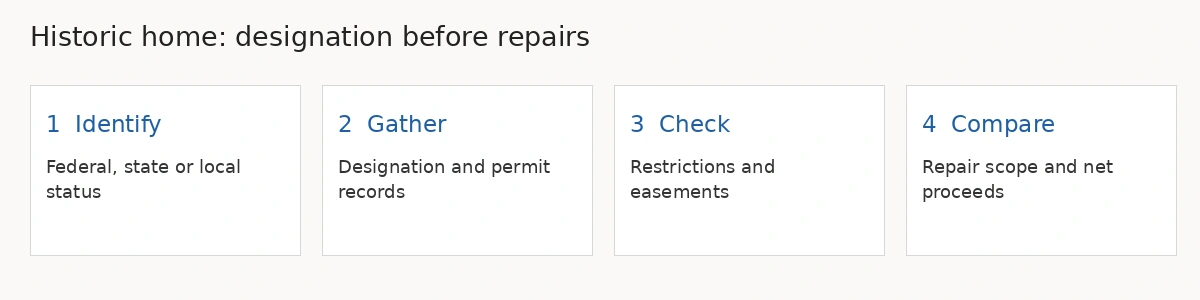
Architectural age and applicable preservation rules are different parts of the sale decision.
Before authorizing work, ask: which authority applies; which features are affected; what existing approvals cover; and what remains for a buyer to verify. Write down the answers and their sources. If the needed tool or specialist report does not exist yet, mark it missing rather than presenting a guessed result.
Our seller's guide helps organize the broader sale. Use the renovation hub for comparing repair obligations, without treating historic designation itself as a defect.
Subtract $26,000 in selling expenses, $18,000 in properly scoped repairs and $5,000 in additional carrying costs: the example net is $371,000 before loan payoff and taxes.
Choose repairs based on condition and applicable approval
Condition problems need their own diagnosis; historic character does not make unsafe materials harmless. Determine both the repair need and the rules governing the proposed work.
An older house may have worn systems or materials requiring specialist evaluation, but age alone does not prove a particular hazard. Our guides to lead paint and asbestos explain their separate assessment and sale considerations. Do not infer a positive finding from a photograph or construction era.
When requesting quotes, describe the actual condition and any verified preservation constraints. Compare scopes rather than just totals: replacing a window and repairing its components are different jobs. A contractor's estimate is not the preservation authority's approval. Likewise, approval does not establish that the chosen contractor can finish by your preferred date.
For undocumented earlier alterations, see selling a house with unpermitted work. Do not assume designation automatically legalizes those alterations or that selling as-is removes the document questions.
Do not assume a historic-home tax credit
A historic label does not automatically create a federal rehabilitation credit for an ordinary owner-occupied home. Check eligibility before counting any incentive in your sale budget.
The NPS tax-incentives explanation describes the federal program for qualifying certified historic structures in depreciable uses, including income-producing uses. That is different from promising every homeowner a credit for repainting, repairs or a sale.
State or local programs, if available, have their own requirements. This guide does not establish eligibility for any property or recommend a tax position. Keep verified incentives separate from the cash you can actually receive at closing. A buyer's plans may differ from yours, and you should not market a benefit as transferable without supporting program guidance.
Worked example: repair-and-list versus an as-is sale
Use actual quotes and written offers to compare net proceeds. These figures are illustrative arithmetic, not market averages or SilverCrest outcomes.
Suppose the anticipated listing price is $420,000. Subtract $26,000 in selling expenses, $18,000 in properly scoped repairs and $5,000 in additional carrying costs: the example net is $371,000 before loan payoff and taxes. An as-is offer of $378,000 with $3,000 in remaining seller expenses gives $375,000 before the same deductions.
The comparison is only useful when each cost is real and each buyer's responsibilities are clear. If required work or documentation affects both options, include it on both sides. Do not count an unverified tax credit or a supposed historic premium. Use our closing-cost calculator to organize the figures, then replace assumptions with written terms.
When a cash sale may not be your best option
Listing may be better for a well-maintained house with clear documentation and time to reach buyers who value its architecture. Historic status alone is not a reason to accept a reduced price.
Compare selling as-is or fixing first. An as-is route can suit someone avoiding project management, but buyer responsibilities and preservation rules still need to be understood. Ask for an explanation of price and conditions rather than treating speed as the only meaningful benefit.
Key takeaways
- Old age does not automatically mean formal designation.
- Federal listing and local controls are different.
- Gather permits, restrictions and designation records first.
- Verify repair scope before committing to renovations.
- Never count an unverified premium or tax credit.
The bottom line
Sell the actual property with its actual records, not assumptions about historic homes. Request a cash offer if you want an as-is comparison. SilverCrest Estates can close in as little as 21 days when requirements allow, or work with a later date you choose.
Frequently asked questions
Does National Register listing prevent a private owner from selling?
National Register listing itself does not impose the same controls as local preservation law. Check the actual designation, state or local requirements and recorded restrictions; do not assume ownership transfer removes them.
Does every old house qualify for historic designation?
No. National Park Service guidance considers age, significance and integrity. A construction date alone does not establish formal designation, so obtain the actual listing or district records before describing the property.
Can I claim a federal tax credit for repairs to my historic home?
Do not assume eligibility. The NPS describes a federal rehabilitation program for qualifying certified historic structures in depreciable uses, not an automatic credit for ordinary owner-occupied-home repairs.
Sources & further reading
Primary sources we consulted for this article. Rules vary by state and change over time — always confirm against the original source.
- 1National Register Frequently Asked Questions
National Park Service
Federal listing distinction and separate state or local requirements.
- 2How to List a Property
National Park Service
Age, significance and integrity are different from automatic designation.
- 3About the Tax Incentives
National Park Service
Federal rehabilitation program scope for qualifying depreciable uses.

About the author
Lisa Anderson
Homeowner Advocate
Lisa Anderson works with the SilverCrest Estates acquisitions team, helping homeowners across 50+ US markets understand their options and close on their own timeline.
Disclaimer: This article is for general information only and is not legal, tax, or financial advice. Real estate rules vary by state and change over time. Consult a licensed attorney, tax professional, or financial advisor about your specific situation before acting.