Start here: this article is part of our seller questions collection. For the full picture, read our complete guide, Can You Sell a House With a Mortgage? Everything You Need to Know.
Quick answer: You can sell a house with an HOA lien, but the unpaid assessments, late fees and allowed collection costs are normally paid from your proceeds at closing so the buyer receives clear title. SilverCrest Estates recommends ordering the association's payoff or estoppel figure early, checking for a pending HOA foreclosure, and confirming whether your state gives part of the lien priority over the mortgage.
| Item | What to request |
|---|---|
| Payoff or estoppel letter | Exact amount owed through closing |
| Ledger | Line-by-line charges to check for errors |
| Collection status | Whether a foreclosure or lawsuit is filed |
| Release | Recorded after payment clears the lien |
Why an HOA lien follows the house
Most community declarations make unpaid assessments a lien on the home itself. That is why a buyer's title company will insist the balance is paid before closing.
Many states also create the lien by statute. In Florida, for example, Florida Statutes section 720.3085 makes unpaid homeowners' association assessments a lien and makes the owner liable for them. Condominium associations usually have similar rules in separate statutes. The glossary entry for HOA lien gives the short definition.
The lien does not usually stop a sale. It changes who gets paid at closing.
Get the real number before you price the house
Ask the association, or its management company, for a written payoff or estoppel statement. Guessing the balance leads to closing-day surprises.
The statement should show regular assessments, special assessments, late charges, interest, attorney fees and any fees for preparing the statement. Ask for a full ledger too. Errors are common when payments were misapplied or when a management company changed.
Florida sets a formal process for these certificates under section 720.30851, including timing for the association's response and limits on certain fees. Other states have different rules, and some leave it to the governing documents. Your title company will normally order the statement, but you can request your own ledger at any time.
Can I dispute charges on the ledger?
Yes. Ask in writing for the basis of any charge you think is wrong and keep proof of payments you made.
Common disputes include late fees on payments that arrived on time, fines that were never noticed properly, and attorney fees that exceed what the documents allow. Resolving a dispute before closing is easier than seeking a refund afterward.
When the HOA has started foreclosure
In many states an association can foreclose its lien. If a case or sale notice exists, the timeline becomes the priority.
Check the county records and court docket for a lis pendens or notice of sale. Texas, for example, regulates the notices a property owners' association must give before certain collection steps under Property Code chapter 209. If a sale date is set, ask the association's attorney for a reinstatement or payoff figure good through your expected closing date, and share the date with your buyer.
Our guide to selling a house with a lis pendens explains how a recorded lawsuit notice affects title.
Does an HOA lien come before my mortgage?
Usually the first mortgage has priority, but some states give part of the association lien super-priority. That matters to lenders and to buyers at an HOA foreclosure.
Nevada is a well-known example: under NRS 116.3116, a limited portion of the association lien, tied to several months of assessments, can have priority over a first security interest. For a seller, priority mostly affects who has leverage if the sale fails. At a normal closing, both the mortgage and HOA balance are paid.
The mortgage payoff is $190,000, and the HOA statement shows $6,800 in assessments, $900 in late fees and $1,750 in attorney fees.
A worked example: netting out the lien
These numbers are an example, not a SilverCrest Estates case. A seller accepts a $265,000 offer on a townhouse. The mortgage payoff is $190,000, and the HOA statement shows $6,800 in assessments, $900 in late fees and $1,750 in attorney fees.
Selling a house with an HOA lien: closing path
- 1
Order the statement
Payoff or estoppel figure.
- 2
Check the ledger
Dispute errors in writing.
- 3
Confirm status
Any HOA foreclosure filed.
- 4
Pay and release
Lien cleared at closing.
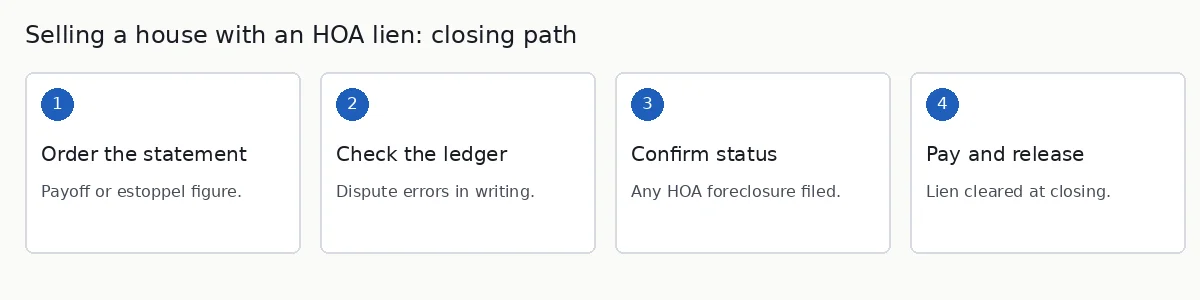
Confirm the payoff, then let the title company pay it.
The seller questions $600 of late fees because bank records show three payments arrived on time, and the association agrees to remove them. The HOA payoff falls to $8,850. With an assumed $5,500 in other closing charges, the example seller nets about $60,650. The settlement agent pays the association directly, and the association records a release.
Special assessments approved but not yet due
A special assessment the board has already approved can affect your sale even if the first installment is months away. Ask about it directly.
Whether the seller or the buyer pays a future installment depends on the governing documents, state law and the purchase contract. Some contracts make the seller pay any assessment levied before closing; others split it or leave it to the buyer. Read the estoppel or resale certificate carefully, because it should list approved assessments, and negotiate who pays before you sign. An unexpected roof or paving assessment of several thousand dollars is a common late surprise in older communities, and it is far easier to price in at the offer stage than to argue over at the closing table.
What if the balance is more than my equity?
If the mortgage, HOA lien and costs exceed the price, you will need the creditors to agree to take less. That is a negotiation, not an automatic outcome.
Ask the association whether it will accept a reduced payoff or waive fees. If the mortgage is also short, the lender may consider a short sale. Our guide to selling a house behind on mortgage payments explains how payoff statements and loss-mitigation requests fit together. The liens and judgments hub collects other title issues.
Disclosures and the buyer's documents
Buyers in an association community usually receive governing documents, budgets and fee information. Many states set this out by statute.
Unpaid assessments are typically shown on the resale certificate or estoppel letter, so disclose the balance from the start. Pending special assessments and known litigation involving the association may also need to be disclosed. Our seller disclosure guide covers the general rules, and the general lien guide explains other lien types.
When a cash sale may not be your best option
An HOA lien alone rarely requires a cash buyer. If the home shows well and the lien is small, a listing may net more.
A cash sale helps when a foreclosure date is near, the home needs repairs, or the owner has moved and wants one closing date. Compare cash offers with listing using the real payoff figure.
Key takeaways
- HOA liens are usually paid from sale proceeds at closing.
- Order the payoff or estoppel statement and full ledger early.
- Dispute incorrect fees in writing before closing.
- Check for a pending HOA foreclosure and its sale date.
- Some states give part of the HOA lien priority over a mortgage.
The bottom line
Know the exact payoff, fix ledger errors and let the title company clear the lien at closing. When you know your net, request a written cash offer to compare; SilverCrest Estates can close in as little as 21 days when title is ready.
Frequently asked questions
Can I sell my house if I owe the HOA?
Usually yes. Unpaid assessments, late fees and allowed collection costs are normally paid from your proceeds at closing, and the association records a release so the buyer receives clear title.
How do I find out exactly what I owe the HOA?
Ask the association or its management company for a written payoff or estoppel statement and a full ledger. Some states, such as Florida, set formal timing and fee rules for these certificates.
Can an HOA lien come before my mortgage?
Usually the first mortgage has priority, but some states give a limited part of the association lien priority. Nevada is a well-known example under NRS 116.3116.
Sources & further reading
Primary sources we consulted for this article. Rules vary by state and change over time — always confirm against the original source.
- 1Florida Statutes section 720.3085
The Florida Senate
Association assessment liens and owner liability.
- 2
- 3Texas Property Code chapter 209
Texas Legislature
Notices required before certain association collection steps.
- 4

About the author
Jennifer Martinez
Real Estate Transaction Specialist
Jennifer Martinez works with the SilverCrest Estates acquisitions team, helping homeowners across 50+ US markets understand their options and close on their own timeline.
Disclaimer: This article is for general information only and is not legal, tax, or financial advice. Real estate rules vary by state and change over time. Consult a licensed attorney, tax professional, or financial advisor about your specific situation before acting.